USAID DEC
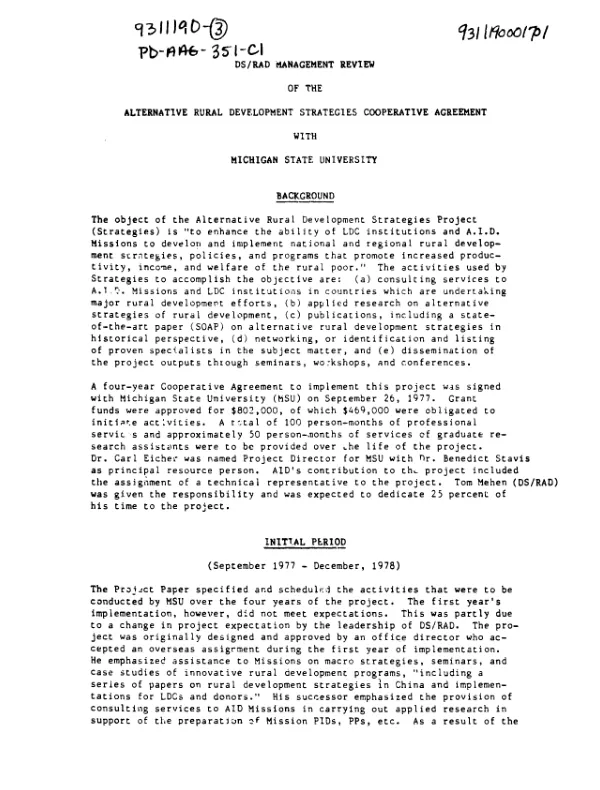
DS/RAD MANAGEMENT REVIEW OF THE ALTERNATIVE RURAL DEVELOPMENT STRATEGIES COOPERATIVE AGREEMENT WITH MICHIGAN STATE UNIVERSITY.
Sign inUSAID. BUR. FOR DEVELOPMENT SUPPORT. OFC. OF RURAL DEVELOPMENT AND DEVELOPMENT ADMINISTRATION
DS/RAD MANAGEMENT REVIEW OF THE ALTERNATIVE RURAL DEVELOPMENT STRATEGIES COOPERATIVE AGREEMENT WITH MICHIGAN STATE UNIVERSITY.
Evaluates project to enhance the ability of A.I.D.
1979
Sign in to readA free account is required to download.
Abstract
Missions and LDC institutions to develop and implement rural development programs. This special AID/W evaluation, attached to a PES (PD-AAG-351-B1), covers the period 9/77-9/80; methodology is unspecified. A change in project management and a refocusing of priorities delayed project implementation during the first year. Activities during the period included 121 days of consulting services provided to Missions; plans made for an applied research program in Haiti; two strategies papers drafted; and a list of specialists made and distributed. Three planned conferences on applied research did not materialize, but a workshop on alternative approaches to extension did take place. During the next 18 months, the project gained momentum. Consulting services, increasingly in demand, were provided to six Missions, primarily in developing background and project papers. Applied research on small farmer agricultural production and marketing systems (farming systems research -- FSR) was initiated in Thailand and Cameroon. Nine papers were published and the state-of-the-art paper (SOAP) was begun. The project received additional funding in 1980 in response to increased USAID demand for project services. The SOAP on FSR was published and followed by two seminars. Four other papers are being prepared, and additional seminars are planned on the SOAP, field work in FSR, and modern data collection methods. Evaluators conclude that the project is achieving its purpose, especially through providing consultant services and diffusing knowledge on alternate rural development strategies. The project should be extended for 30 months and analytic work should continue on the cost-effectiveness of alternative data collection methods; institutionalization issues; integration of cropping and livestock production; consumption effects of alternative production; and the relationship of production/consumption to policies and infrastructure. Other recommendations are that the level of professional and student effort be maintained and that information dissemination receive greater emphasis.