USAID DEC
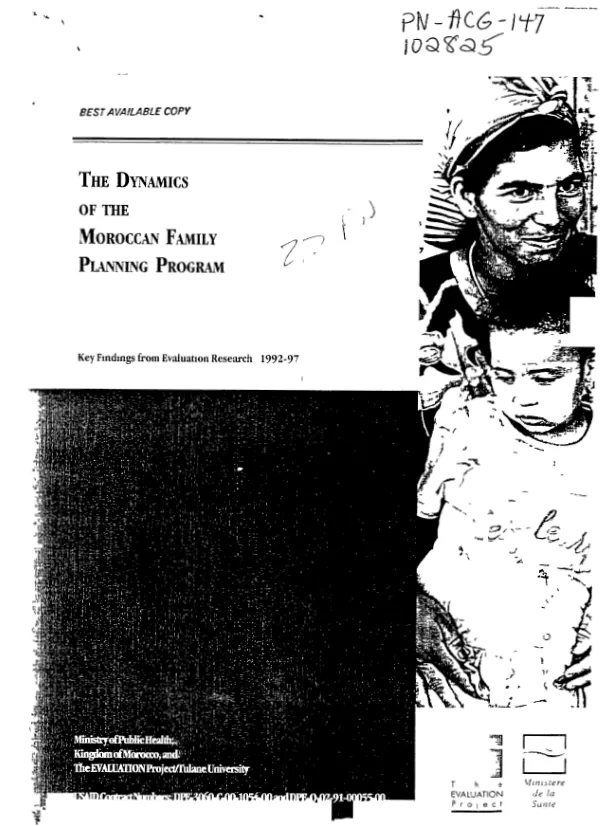
Dynamics of the Moroccan family planning program : key findings from evaluation research, 1992-1997
Sign inMOROCCO. MINISTRY OF PUBLIC HEALTH
Dynamics of the Moroccan family planning program : key findings from evaluation research, 1992-1997
Summarizes key findings of research conducted by the Evaluation Project between 1992 and 1997 on the maternal child health/family planning (MCH-FP) program in Morocco.
Bertrand, Jane T. · 1998
Sign in to readA free account is required to download.
Abstract
Key findings include the following: (1) Access to contraceptive methods is high, with 98% of women living within 30 km of a facility offering FP services. The pill is available in almost all government health facilities, the IUD in about two-thirds of urban and one-third of rural facilities. (2) A 1992 pilot study in five provinces indicated that most facilities had the infrastructure, equipment, and supplies necessary to deliver FP services; pills and condoms were widely available. Shortcomings included inadequate supplies of Ovrette, less than universal availability of the IUD, and a dearth of printed IEC materials. These results guided subsequent efforts to improve quality. (3) Despite a substantial investment by the Ministry of Health (MOH) and USAID/Morocco in training service providers, the percentage of women of reproductive age using the IUD only increased from 3% to 4% between 1992 and 1995. A qualitative study revealed several problems: provider bias in favor of the pill, rumors regarding "getting hooked together," and fear of side effects. The study prompted a new cycle of refresher training in regional centers throughout the country. (4) One of the most innovative aspects of the evaluation work in Morocco has been the development of an interactive computerized system that provides program managers with easy access to 20 MCH/FP indicators. The system produces tables, graphics, and maps for each indicator over a 5-year period (1992-96), as well as for the different levels (national, regional, and provincial). It can also be used to generate a chartbook of results for any indicator, year, and level. Numerous secondary analyses were conducted of Demographic Health Survey (DHS) data, including the service availability module (SAM). Four studies involving contraceptive use and other reproductive health (RH) behavior utilized the state-of-the art approach promoted by the Evaluation Project, namely, measuring the effect of FP service environment on contraceptive use. Key findings were as follows: (1) The percentage of women who discontinued their contraceptive method within the first 12 months varied from 1% for the IUD to 39% for the pill to 51% for traditional methods. Reasons for discontinuation varied by method: pill users tended to desire another pregnancy, whereas IUD users cited side effects. Failure rates (by 12 months) were much lower for the IUD (3%) and the pill (6%) than for traditional methods (22%). Results point to the importance of improving method-specific counseling. (2) Data from 567 matched couples from the 1992 DHS allowed for a husband/wife comparison of fertility desires. The analysis examined three possible factors affecting a woman's contraceptive use: her own fertility desires, her perception of the husband's fertility desires, and the husband's actual fertility desires. For women wanting to delay a birth, only the first two mattered. However, when a woman wanted to limit her family size, both her perceptions and her husband's actual fertility desires influenced her behavior. Further emphasis on male involvement in FP will help improve husband-wife communication on this subject. (3) Women who used MCH services were more likely than others to adopt contraception, even after controlling for other factors. This relationship was stronger where the FP service environment was more favorable. (4) A study of non-users who "intended to use" in 1992 and their actual contraceptive use as of 1995 revealed that (a) stated intentions are an important predictor of subsequent use, and (b) a favorable FP supply environment facilitates contraceptive adoption. The results indicate that the Morocco FP program not only satisfies existing demand but also generates new demand. (5) Two studies assessed the impact of the FP program on contraceptive use. The first used cross- sectional data to test the relationship of program factors (access/quality) and community- and individual-level characteristics on a series of five RH behaviors. Results were inconclusive, most probably for methodological reasons. The second analysis, which used a more powerful analytic approach based on longitudinal data, demonstrated the effect on contraceptive use of the supply environment, especially the training of nurses and the infrastructure at the closest facility. These findings suggest that in countries with mature programs, longer observation periods are necessary to evaluate impact.