USAID DEC
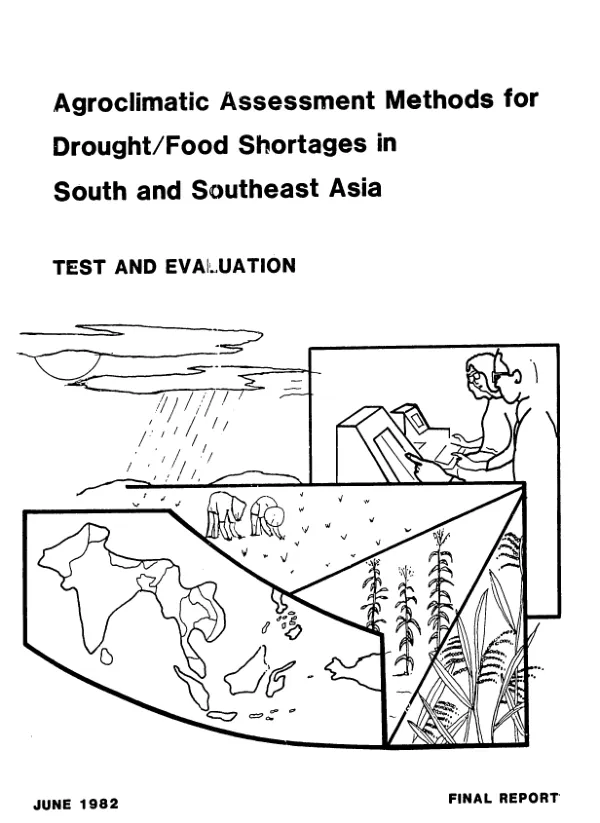
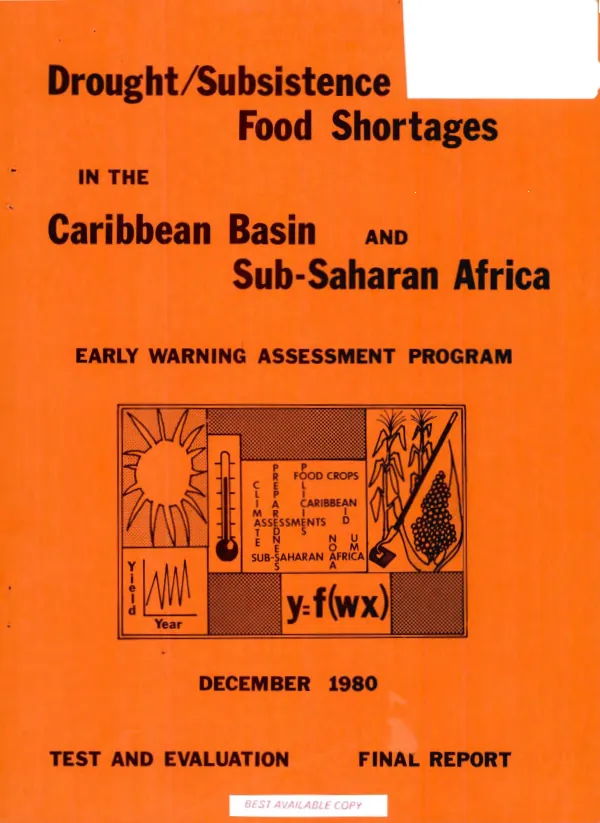
Early warning assessment program for drought/subsistence food shortages in the Caribbean Basin and sub-Saharan Africa; final report on test and evaluation
Sign inU.S. NATIONAL OCEANIC AND ATMOSPHERIC ADMINISTRATION (NOAA). NATIONAL ENVIRONMENTAL SATELLITE, DATA AND INFORMATION SERVICE (NESDIS)
Early warning assessment program for drought/subsistence food shortages in the Caribbean Basin and sub-Saharan Africa; final report on test and evaluation
Because potential drought-related food shortages can be predicted through early warning assessments based on weather, climatic, and agronomic data, A.I.D.
Steyaert, Louis T.; Ravelo, Andres C. +1 more · 1980
Sign in to readA free account is required to download.
Abstract
sponsored two projects to develop an early warning program in the Caribbean Basin and Sub-Saharan Africa, respectively. This report presents the results of tests and evaluations of the assessment program. After a brief overview of the two projects, the authors describe the preparation of weekly weather assessments and monthly crop condition/food shortage assessments. They proceed to verify the early warning assessment program"s accuracy and utility during 1978-80 in the Caribbean, using historical and climatic analyses of Haiti covering a 35-year period; and in Africa, relying on documented reports from A.I.D. Missions and from the Food and Agricultural Organization. The authors conclude that the agroclimatic assessments can provide useful information 30-60 days prior to harvest, representing a 3-6 month warning of abnormal food shortages, in any country of the Caribbean Basin or Sub-Saharan Africa. The program can potentially allow A.I.D. to achieve a cost-effective response capability in monitoring and assessing potential drought-induced disasters; increasing U.S. capacity to define disaster-prone conditions and recommend disaster avoidance measures; and in applying and transferring such information to developing countries and international organizations. It is recommended that future changes in agricultural practices or socioeconomic conditions be incorporated into the assessment procedures; crop condition assessment be more localized; historical yield indices be expressed as raw, percentile, and percent of normal figures; and that time series plots of meteorological variables be examined throughout the crop season. It is also recommended that the yield moisture index be used as the primary indicator in the Caribbean and that the crop moisture ration be used in Africa. Appended to the report and comprising the supplemental volume are weekly weather assessment data for the two regions, an evaluation of the 1979 growing season, and a description of an episodal event data base for the Caribbean.
Related documents
Documents in this collection
 1986
1986USAID DEC
Sahel course lesson plans -- special climatic impact assessment for crops and rangelands : agroclimate and remote sensing techniques used by NOAA/NESDIS/AISC
Open record 1983
1983USAID DEC