USAID. MISSION TO EL SALVADOR
Earthquake reconstruction
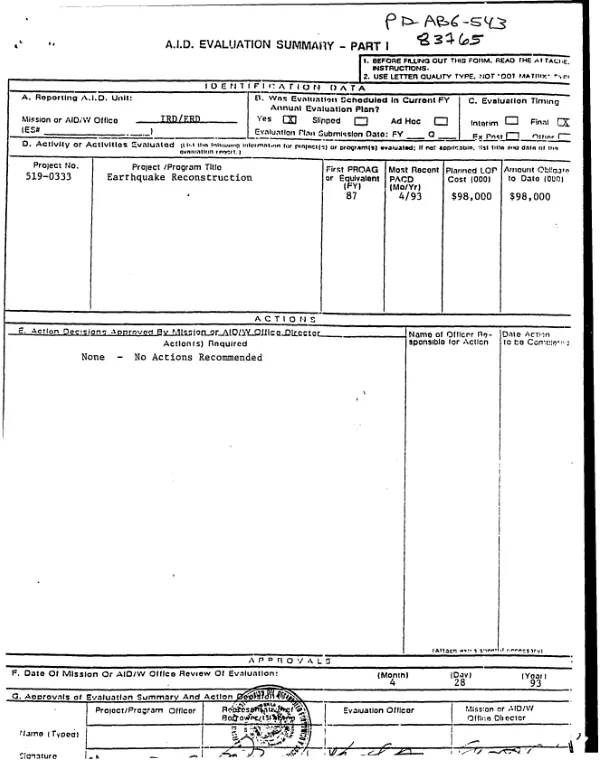
Summarizes final evaluation (XD-ABG-543-A) of a project (1987-4/93) to reconstruct public and private infrastructure destroyed by the 10/86 earthquake in El Salvador.
1993
Sign in to readA free account is required to download.
Abstract
The project exceeded its physical targets by far. This was due in part to a shift in funds from credit lines, which proved unnecessary, to infrastructure, and in part to the declining value of the colon vs. the dollar. The project constructed/reconstructed, and in some cases equipped: over 13,000 low-income housing units on 103 sites (some of them with child care facilities added) in and around San Salvador; 14 major public markets; over 2,200 classrooms and 800 administrative and support areas in 235 schools; 7 public health and medical facilities; and 24 km of highway. In addition, the project extended credit for the reconstruction or rehabilitation of 4 large private schools, 3 small businesses, and 20 private medical facilities. These accomplishments required the management of 588 contracts or other procurement actions by or through 9 government agencies, the City of San Salvador, and four PVOs. While this would have been a remarkable achievement under any circumstances, it has to be rated as outstanding under the conditions actually prevailing, which included: active guerilla warfare, resulting in frequent power outages, transportation strikes, and a guerrilla incursion into San Salvador that shut work down for a month; high rates of inflation; and certain Salvadoran administrative procedures which caused long delays in the execution of some construction contracts. The Mission organization for this project and the implementing arrangements set up between the Mission and the Government of El Salvador were innovative and provide A.I.D. with models for future projects. The project demonstrated the importance of the Project Manager, who was a key ingredient in this project"s success. Other lessons learned were as follows. (1) National professional personnel can be used to advantage in high-level project management positions. (2) The creation of a Project Financial Manager was an beneficial innovation that should be used more widely. (3) Continual "on the ground" monitoring of the project"s progress, together with the use of Monitoring Committees, helped management anticipate problems before they became serious. (4) Delegation of authority from A.I.D/W to the Mission allowed for maximum flexibility in project management and consequently for optimal accomplishment. Lastly, however, the project raises questions about the manner in which its outputs can be integrated into the line offices of the Mission so that the new infrastructure does not fall into disrepair due to lack of maintenance. The Mission is developing strategies to deal with these issues.
Related documents