USAID DEC
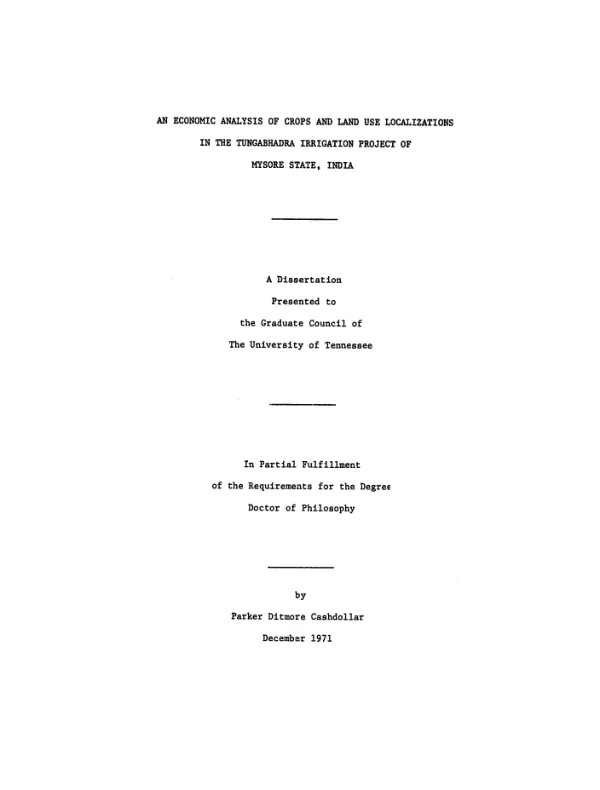
Economic analysis of crops and land use localizations in the Tungabhadra irrigation project of Mysore State, India
Sign inUNIVERSITY OF TENNESSEE
Economic analysis of crops and land use localizations in the Tungabhadra irrigation project of Mysore State, India
The general objective of this study is to construct an economic model for use in analyzing agricultural phenomena in the black soil area of the TBP.
Cashdollar, P. D. · 1970
Sign in to readA free account is required to download.
Abstract
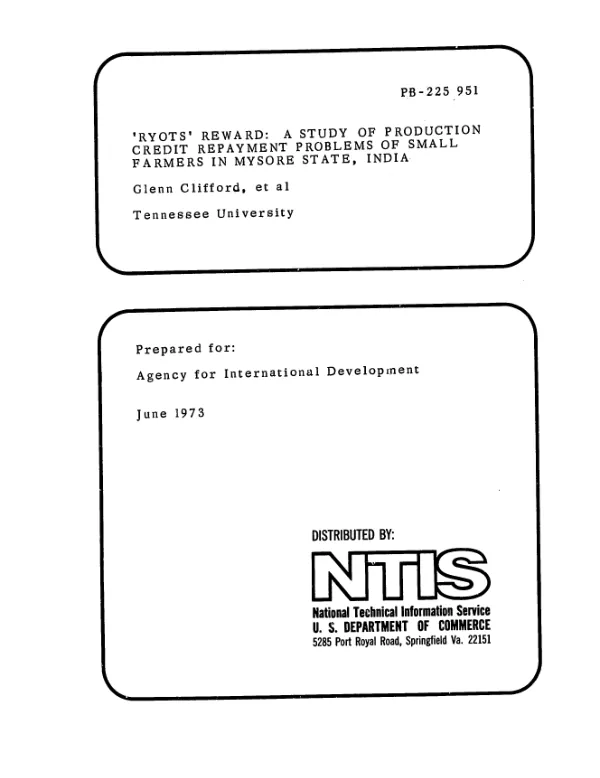
The Fortieth Distributary was selected as the unit of analysis and representative farms were constructed for this distributary based on primary resource data collected from a random sample of farmers. This study investigates the profitability of various dryland and irrigated crops grown on the representative farms assuming that localization regulations are strictly enforced. Linear programming analysis is used to determine the most profitable crops grown on representative farms under two sets of localization regulations for the Fortieth Distributary. Also, three models are considered in which various levels of operating credit and land developed for irrigation are assumed to be available. An aggregate analysis is also made to determine the total input requirements and production that are likely on the distributary under six different sets of localization regulations.
Connected topics