USAID. BUR. FOR LATIN AMERICA AND THE CARIBBEAN
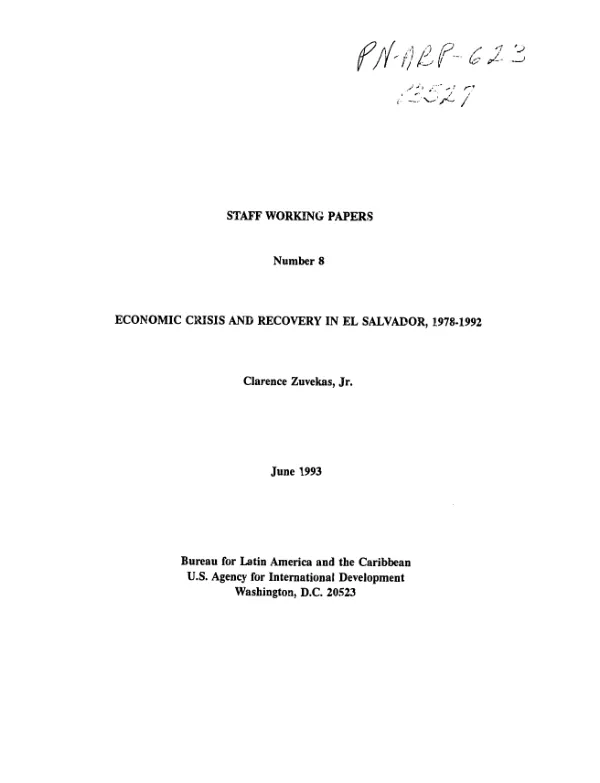
Economic crisis and recovery in El Salvador, 1978-1992
El Salvador"s economy experienced moderately rapid economic growth during most of the 1970s.
Zuvekas, Clarence, Jr. · 1993
Sign in to readA free account is required to download.
Abstract
Real aggregate GDP rose at an average annual rate of 5.1% between 1969 and 1978, while real per capita GDP grew by 2.5% a year, roughly equal to the Central American average (2.6%) in the pre-crisis decade or so (rates for individual countries vary from 8-11 years). Per capita consumption, fueled toward the end of the period by a boom in coffee prices, rose by 3.5% a year. Meanwhile, political and social conditions in the country were deteriorating. The outbreak of civil war in the late 1970s triggered a sharp economic decline which began in the 1979 and was aggravated by the 1980-82 world recession. This paper begins by briefly tracing the dimensions of El Salvador"s economic crisis; discussing the domestic and external factors that made the decline in per capita GDP the second most severe in the region (after Nicaragua"s); and examining the policy measures adopted by Salvadoran governments in the early 1980s to overcome the crisis. A similar exercise is then carried out for the period of very slow economic recovery (virtual stagnation in real per capita GDP) between 1983 and 1989, and for the more rapid (but still moderate) recovery since then. Finally, concluding observations provide some comparisons between El Salvador and Nicaragua and highlight major obstacles to sustained economic recovery and social peace during the remainder of the 1990s. The paper argues that better economic policies since 1990 explain part, but by no means all, of the improvement in economic performance beginning in that year. It also maintains that El Salvador"s economy emerged from civil war in a much healthier condition than that of Nicaragua, which suffered from an internal conflict of comparable destructiveness while receiving a similar amount of external economic assistance. (Author abstract)
Related documents