USAID. MISSION TO PHILIPPINES
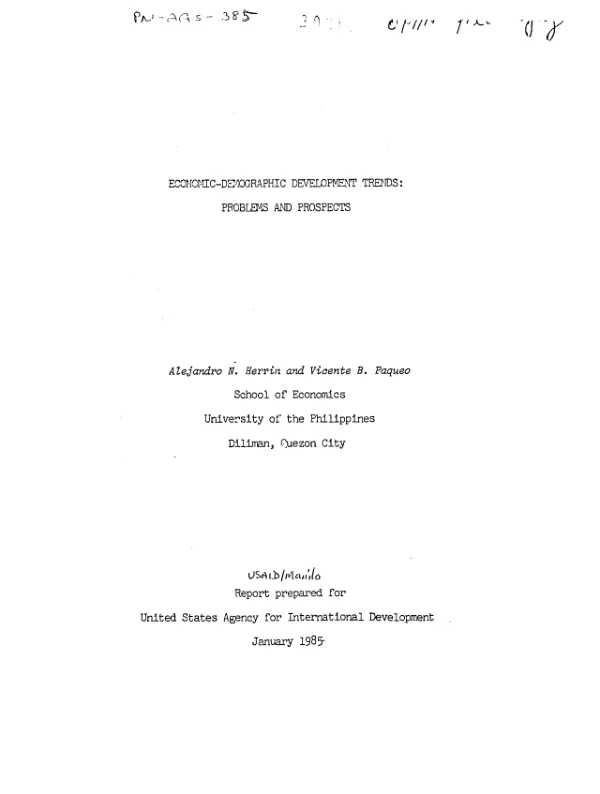
Economic - demographic development trends : problems and prospects
The interaction of demographic and economic trends in the Philippines is analyzed with regard to development prospects.
Herrin, Alejandro N.; Pacqueo, Vicente B. · 1985
Sign in to readA free account is required to download.
Abstract
Analysis of demographic trends up to 1983 and of the short-term demographic implications of the country"s current economic crisis reveals a slowing down of fertility declines, the probability that mortality declines will decrease, and the likelihood of an increasing demand by couples for fertility control services. Analysis of the relation between demographic and economic factors (including the economy"s political and institutional context) in terms of the country"s rapidly growing labor force indicates that reducing the labor supply through fertility reduction will greatly facilitate attainment of the long-term objective of full employment with rising real wage rates. Finally, an assessment of the Philippine population control program recommends increasing efficiency through better specification of the target population and extending the Outreach Project to uncovered areas. Also recommended are efforts to remove the ambivalence of policymakers towards population control (by stressing the positive economic impacts of slower population growth) and to integrate economic concerns into fertility reduction programs for couples. POPCOM"s proposed cost-recovery plan for contraceptives is viewed as regressive and inequitable during the current economic crisis. Included are 10 tables and a 4-page bibliography (1966-84).
Connected topics