USAID DEC
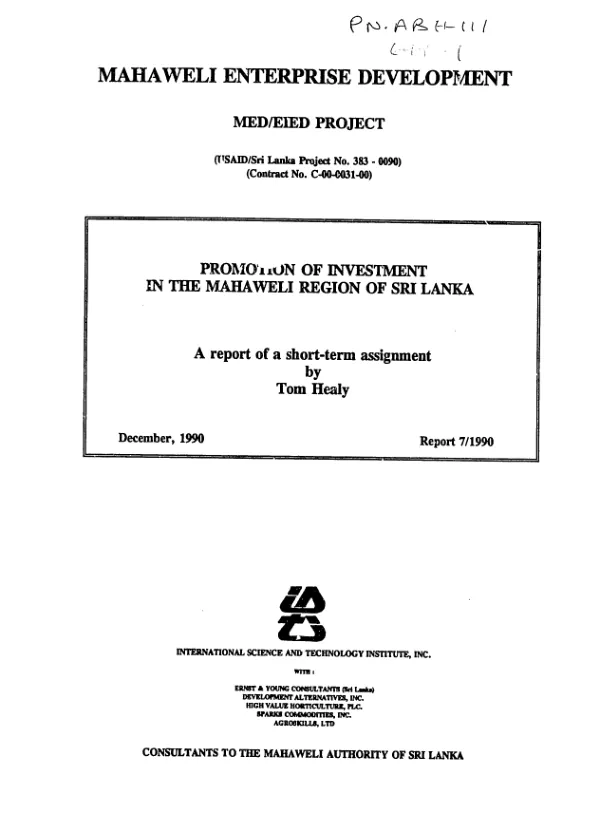
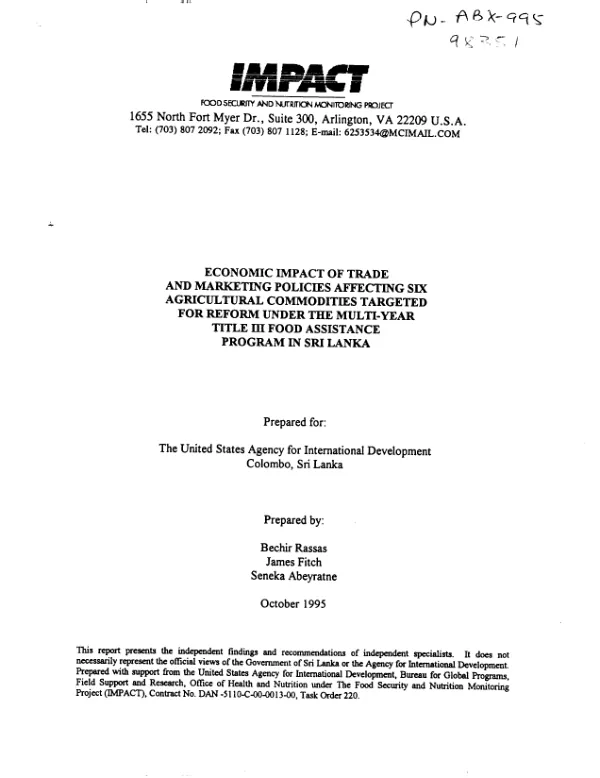
Economic impact of trade and marketing policies affecting six agricultural commodities targeted for reform under the multi-year Title III food assistance program in Sri Lanka
Sign inINTERNATIONAL SCIENCE AND TECHNOLOGY INSTITUTE, INC. (ISTI)
Economic impact of trade and marketing policies affecting six agricultural commodities targeted for reform under the multi-year Title III food assistance program in Sri Lanka
USAID/Sri Lanka has developed a Multi-Year Title III Food Assistance Program to help liberalize food trade and marketing in the country, with six commodities targeted for reform: rice, wheat, onions, chilies, lentils, and seed potatoes.
Rassas, Bechir; Fitch, James +1 more · 1995
Sign in to readA free account is required to download.
Abstract
This report analyzes the effects of the Mission"s reform effort. The policy studies conducted under the program were not only instrumental in building the case for accelerating the needed adjustments, but were used to document the need for further reform in subsequent reports prepared by the Government of Sri Lanka, USAID, the World Bank, and other international agencies. Data for recent years also show that considerable effort has been made under the program to increase private sector participation in marketing of the six commodities under consideration. Analysis in this study demonstrates that while consumers" welfare increases significantly with liberalization, producers" overall income and government revenue decline. For commodities where import quotas are in effect, traders lose the excess profit or rent they earn as a result of the quota system. However, the fact that gains to consumers outweigh the combined losses of producers, traders, and the government demonstrates that liberalization results in net social gains. A crop-by-crop analysis indicates that some of the recent policy changes that have reduced tariff and/or non-tariff restrictions have resulted in similar net benefits. However, other changes have created significant policy distortions. (Author abstract)