USAID DEC
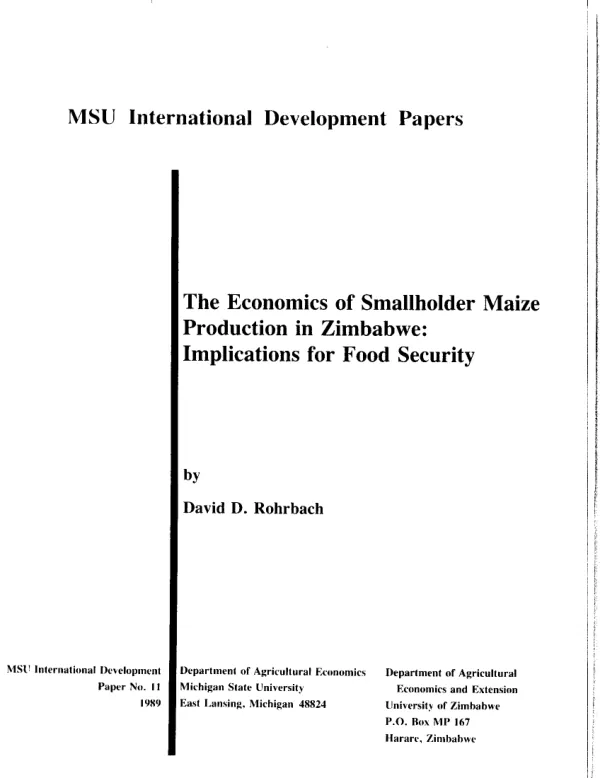
Economics of smallholder maize production in Zimbabwe : implications for food security
Sign inMICHIGAN STATE UNIVERSITY. DEPT. OF AGRICULTURAL ECONOMICS
Economics of smallholder maize production in Zimbabwe : implications for food security
Maize production has grown apace in post-independence Zimbabwe, especially among smallholders.
Rohrbach, David D. · 1970
Sign in to readA free account is required to download.
Abstract
Between 1979 and 1985, the harvests of these farmers tripled, constituting one-third of the formal markets. This report briefly reviews the trends in Zimbabwe"s maize production, sales, stocks, and trade from 1970 to 1986, and then identifies the key policy, institutional, and technological sources of growth in smallholder production. The implications of these trends for the nation"s food security are discussed, including an assessment of the distribution of gains from maize production and sales among smallholders and the factors involved in this distribution. Finally, the challenges facing Zimbabwe to further improve household food security are examined. According to the report, Zimbabwe is clearly better off as a result of the increase in smallholder maize production. Average household food supplies have sharply increased and rising crop sales have improved average small farm incomes. However, despite the nation"s large aggregate production surpluses, a significant proportion of small farmers still face transitory and chronic food deficits. The achievement of food security for all smallholders requires broader distribution of food production gains. Policies should therefore encompass strategies affecting food access as well as food supply.