COOPERS AND LYBRAND
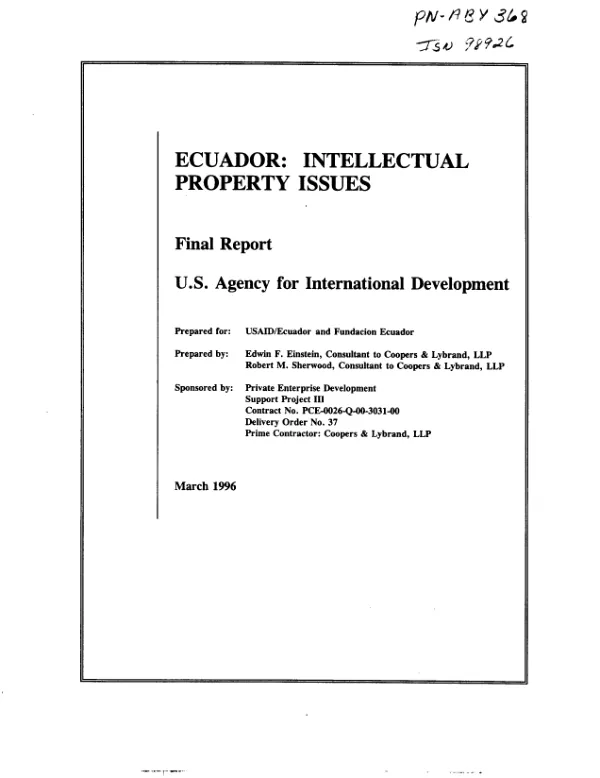
Ecuador : intellectual property issues (final report)
Ecuador"s intellectual property system exhibits both strengths and weaknesses.
Einstein, Edwin F.; Sherwood, Robert M. · 1996
Sign in to readA free account is required to download.
Abstract
Emerging strength comes from the three Andean Community (ANCOM) decisions adopted in 1994 under the Cartagena Agreement; weaknesses exist in judicial enforceability and public administration. Section I of this report compares Ecuador"s intellectual property regime with those of other Latin American and Caribbean countries and examines three options for system improvement: (1) the Agreement on Trade-Related Aspects of Intellectual Property Rights (TRIPS), the global intellectual property standard which emerged from the Uruguay Round of multilateral trade negotiations; (2) Chapter 17 of the North American Free Trade Agreement (NAFTA), which improves upon TRIPS in some regards; and (3) investment-oriented protection, the real test of an intellectual property system. Section I next assesses the eight components of Ecuador"s intellectual property system: judicial enforceability of intellectual property rights; public administration; copyright and related rights; patents; trademarks; trade secrets; higher life forms; and treaties. Section II of the report presents several one-page case examples illustrating the effects of inadequate intellectual property protection on inventive and creative individuals in Ecuador, along with a second set of case examples deriving from the authors" experience in other countries. The Ecuadorian examples address issues relating to inter alia, the software industry, genetic engineering, videotape productions, university research, and biodiversity. Annexes to the two sections include references, a rating scale for investment-oriented intellectual property protection, and a list of suggested speakers for intellectual property seminars in Ecuador.
Related documents