USAID
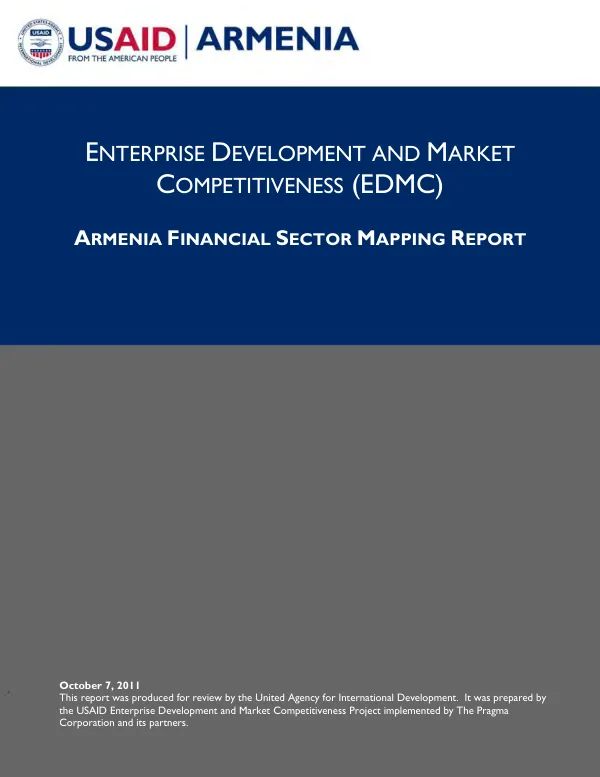
EDMC Financial Sector Mapping Report
The Enterprise Development and Market Competitiveness (EDMC) project in Armenia aimed to increase the competitiveness of the country's economy through financial sector development.
2011 · 53 pages
Sign in to readA free account is required to download.
Abstract
The project was implemented by The Pragma Corporation and its partners, with funding from the United States Agency for International Development (USAID). The financial sector in Armenia is characterized by a high level of liquidity among commercial banks, but a low rate of provision of financial services to Small and Medium Enterprises (SMEs). The main challenges in increasing SME lending outreach include poor client awareness and analysis, insufficient staff capacity, limitations on resources for lending in Armenian Drams (AMD), low SME ability to apply for credit, and high outreach costs. The study identified several key findings, including the reluctance of banks to target the SME sector due to risk aversion and lack of market understanding. SMEs, particularly smaller companies, lack formal credit histories, formal collateral, and skills in financial management and market analysis. Capacity is lacking on all sides, including among banks, SMEs, and other stakeholders. The study also highlighted the significant demand for credit services by individual businesses and SME borrowers, demonstrated through previous USAID-funded projects, desktop research, and direct observation. However, Armenian SMEs face a range of issues related to low profitability and low capacity, making it difficult for them to approach the banking sector. The report makes several recommendations to increase value-chain lending in Armenia, including the need for financial and technical assistance to support financial institutions in increasing their lending activities. The report also emphasizes the importance of addressing the capacity gaps on all sides, including among banks, SMEs, and other stakeholders. The study was conducted under the EDMC project, which represents the 4th generation of USAID and other donor funding of bank training and capacity-building. The project aims to increase the competitiveness of Armenia's economy through financial sector development. The report presents a high-level financial sector mapping analysis, including a questionnaire tool and database, as well as a draft selection framework for selecting partner banks to participate in future diagnostics. The report also includes a draft Financial Intermediation component work plan and baseline data capture framework. The study was conducted by Dan Gies and Aurica Balmus, with review by Alan Martinez. The report is based on primary and secondary data collected from financial institutions in Armenia, including commercial banks, universal credit organizations, and others. The study focuses on the SME sector, examining closely the credit environment for businesses employing from 5-250 people and having an identified credit need of roughly $5,000 - $2,500,000. The report includes a table of contents, with chapters on executive summary, project background, Armenian financial sector map, challenges in increasing SME lending outreach, recommendations, year one work plan input to support methodology, and conclusion. The report also includes annexes, including a list of interviews, lending institution detailed interview guidelines, partner lending institution scoring matrix, snapshot of Armenian financial institutions, summary data overview of commercial banks, and A2F qualitative survey tool - draft. The report highlights the need for a comprehensive approach to address the capacity gaps on all sides, including among banks, SMEs, and other stakeholders. The report also emphasizes the importance of increasing financial and technical assistance to support financial institutions in increasing their lending activities.
Related documents