INDONESIAN MINISTRY OF RESEARCH, TECHNOLOGY, AND HIGHER EDUCATION
Education in South Sudan
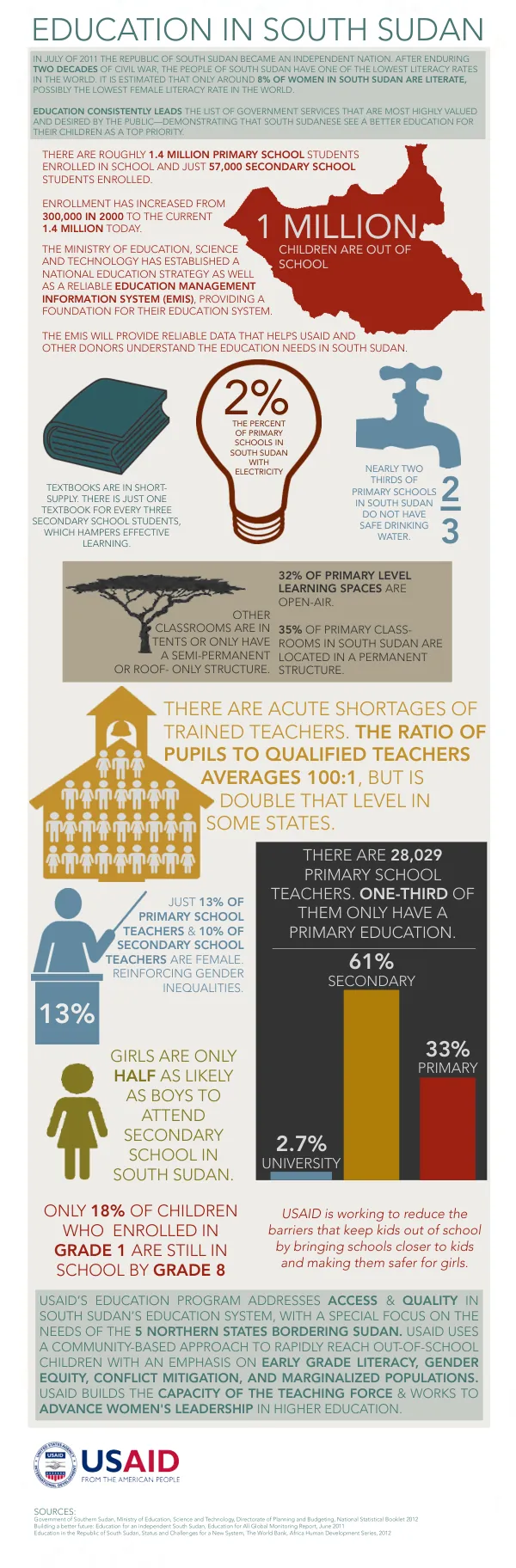
South Sudan's education system faces significant challenges, with nearly two-thirds of primary schools lacking safe drinking water.
2013 · 1 pages
Sign in to readA free account is required to download.
Abstract
Only 2% of primary schools have electricity, and education consistently ranks as a top priority for the public. The country has made progress in increasing enrollment, with 1.4 million primary school students and 57,000 secondary school students enrolled, up from 300,000 in 2000. However, the education system is plagued by issues such as open-air learning spaces, with 32% of primary level learning spaces lacking roofs. Additionally, 35% of primary classrooms are located in permanent structures, while the remainder are in tents or have semi-permanent or roof-only structures. The shortage of textbooks is also a significant concern, with only one textbook available for every three secondary school students. Girls face significant barriers to education, with only half as many girls as boys attending secondary school. Furthermore, only 18% of children who enrolled in grade 1 are still in school by grade 8. The acute shortage of trained teachers is another major issue, with a pupil-to-qualified-teacher ratio averaging 100:1, and reaching as high as 200:1 in some states. One-third of primary school teachers have only a primary education, and just 2.7% of secondary school teachers have a university education. The Ministry of Education, Science and Technology has established a national education strategy and a reliable education management information system (EMIS), which will provide reliable data to help USAID and other donors understand the education needs in South Sudan. However, the education system still faces significant challenges, including a lack of female teachers, with just 13% of primary school teachers and 10% of secondary school teachers being female.