USAID DEC
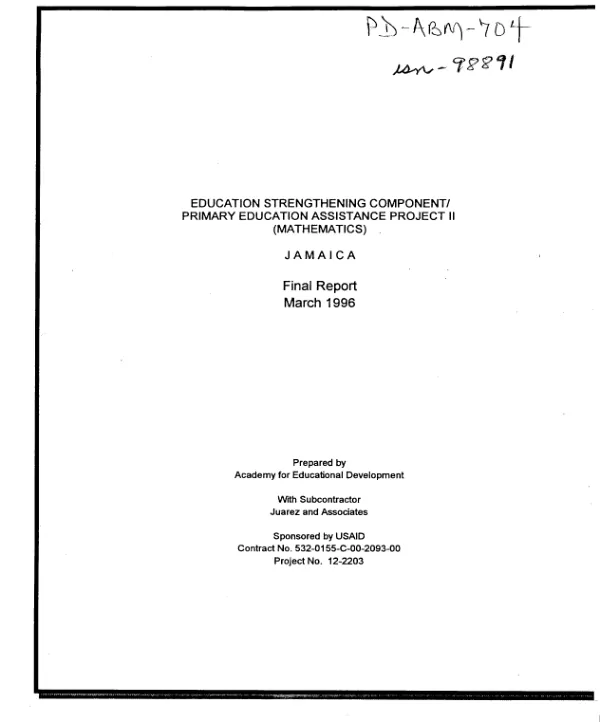
Education strengthening component/primary education assistance project II (mathematics) -- Jamaica : final report
Sign inACADEMY FOR EDUCATIONAL DEVELOPMENT, INC. (AED)
Education strengthening component/primary education assistance project II (mathematics) -- Jamaica : final report
Final contractor report on the education strengthening component (10/92-3/96) of Primary Education Assistance Project (PEAP) II in Jamaica; the component"s purpose was to help the Ministry of Education, Youth and Culture"s (MOEYC) plans to rapidly upgrade primary school mathematics instruction.
1996
Sign in to readA free account is required to download.
Abstract
Although the component focused on mathematics, it was intended to lay the foundation for developing instructional materials, training, and assessment throughout the primary education curriculum. TA specialists from the Academy for Educational Development (AED), the prime contractor, and Juarez and Associates, the subcontractor, and their MOEYC counterparts implemented the following activities. (1) The mathematics curriculum was reviewed, and recommendations for its revision were approved and implemented. (2) Mathematics textbooks were reviewed, and recommendations were made. (3) Instructional materials were developed to support specific areas of the curriculum. (4) Pre-service and in-service teacher training activities were designed to prepare teachers to use the ancillary teaching materials and to incorporate new mathematics teaching approaches and assessment strategies. (5) The National Assessment Programme (NAP) was strengthened to help teachers more effectively track students" progress in mathematics. While the educational strengthening component complemented the efforts of other international donor-assisted projects to improve Jamaican primary school education, particularly those that addressed mathematics education, it also helped prepare the way for comparable reforms of curriculum, teaching, and assessment policies and practices in other disciplines. Any long-term TA project in a developing country is subject to constraints (e.g., limited resources, understaffing and overassigning counterpart staff, insufficient data bases, political exigencies). This said, there is usually an enormous reservoir of professional good will and commitment to a project, and the education strengthening component was no exception. From the ministerial level down on through the Joint Coordinating Committee, to USAID, a concerted effort provided the resources and thinking to make the project successful. A number of lessons emerged. (1) Sustainability of results must be introduced at the outset and be a constant theme through all aspects of the project. The progress made in training 140 Master Resource Teachers, introducing new pedagogical approaches through replacement units, and refining the National Assessment Program should be viewed not as ends, but as a foundation on which to build. This will require the MOEYC to constantly renew its commitment to professional development to improve primary school mathematics instruction. (2) If donors coordinate their efforts they may be able to reduce the demands and maximize the time and productivity of staff who are assigned to their projects. (3) Participatory decision making can reinforce individual commitment to a project at every level. (4) The importance of a Joint Coordinating Committee to program effectiveness and sustainability cannot be overstated.
Related documents