EDUCATION DEVELOPMENT CENTER, INC. (EDC)
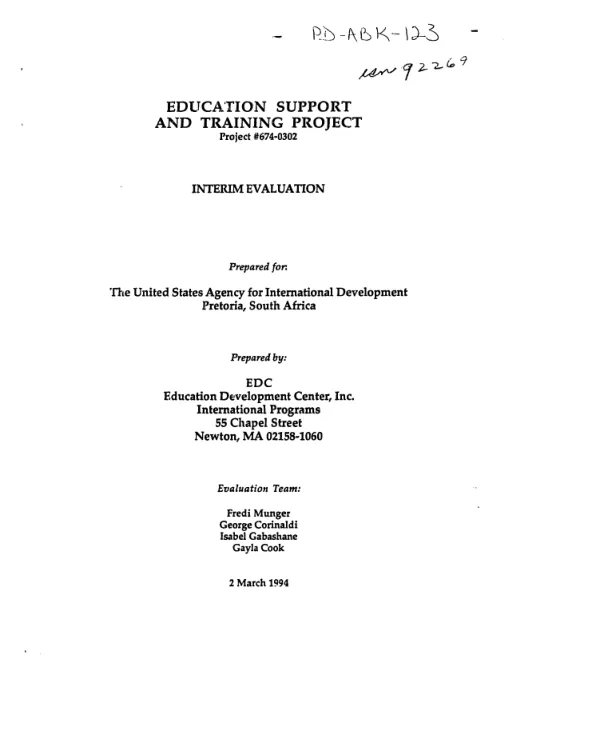
Education support and training project -- project no. 674-0302 : interim evaluation
Evaluates umbrella project to support the efforts of indigenous NGOs to test improved methods for providing basic education to disadvantaged blacks in South Africa (ESAT project).
Munger, Fredi|Corinaldi, George · 1994
Sign in to readA free account is required to download.
Abstract
Interim evaluation covers the period 1986-93. This largely successful, well-managed project is on target in meeting its purposes and planned outputs. The greatest portion of project funds (86%) have been invested in 81 NGOs working in the project's seven focus areas (models for decentralized education, curriculum development and educational planning, professional teachers' skills upgrading, expanded access to secondary education, post-secondary school remediation, applied adult literacy training, and preparation for schooling and primary education), with a very small portion invested in TA buy-ins and service contracts. Based on a sample of 30 grantees, impact of service provision has been substantial, far exceeding the project paper's modest expectations. According to grantee reports, tens of thousands of South Africans have received direct or indirect benefits as a result of education providers trained, teachers whose skills have been upgraded, materials which have been developed to help students pass examinations, and lessons from adult educators trained through literacy programs. Unfortnately, the project reached only an insignificant portion of beneficiaries in any given focus area, and while some pilot projects have developed useful models adoptable by the government, these models have not yet been tested to scale, the stage at which promising pilot projects often fail; the success of the pilot projects is largely due to the efforts of an enthusiastic staff concerned less with remuneration than with reaching their goal. As the pilots are taken over by the government and civil servants, they may lose momentum; it is thus not yet safe to say that a particular model or approach will be effective at scale. No additional grantees should be added to the portfolio. The project may have already funded most of the organizations that qualify for and have the capacity to absorb USAID funds, and the grantee-to-management staff ratio is already so high that adding to the portfolio could compromise program quality. On a positive note, the project should consolidate activities in areas where NGOs are likely to continue playing a major role in direct service provision (i.e., adult basic education and pre-school education), as governments tend to retain matters such as curriculum development and teacher education for themselves. Support for NGO participation in the educational policy debates also should be continued, as it is a new niche for NGOs and one in which they have valuable experiences to share with policymakers. Finally, the project should increase efforts at systematic reflection and in building grantee organizational, project evaluation, and curriculum review capacities. Lessons learned are as follows. (1) ESAT has provided financial and technical support to NGOs in an increasingly cost-effective manner and provides a potential model for USAID-NGO collaboration in other countries even apart from success factors unique to the South African context. Transferable factors include the absence of institutional contractors, high levels of funding, strong project staff, clear mission strategies and policies, use of centrally funded buy-ins for technical support, creative use of market forces, and built-in quality control and improvement mechanisms. (2) ESAT has demonstrated that an aggressive strategy against the inequities of apartheid, as opposed to business-as-usual, constructive engagement policy advocated in the U.S. administration in 1986, was justified and productive. In short, Congress was right, and given powerful backing underwritten by substantial appropriations, USAID/SA was able to both fulfill the political agenda of Congress and actively engage in helping South Africa's education sector reform itself.
Related documents
Documents in this collection
 1996
1996USAID DEC
Improving educational quality project : an assessment of NGO Educare training -- February 1996
Open record 1996
1996USAID DEC