MICHIGAN STATE UNIVERSITY. DEPT. OF AGRICULTURAL ECONOMICS
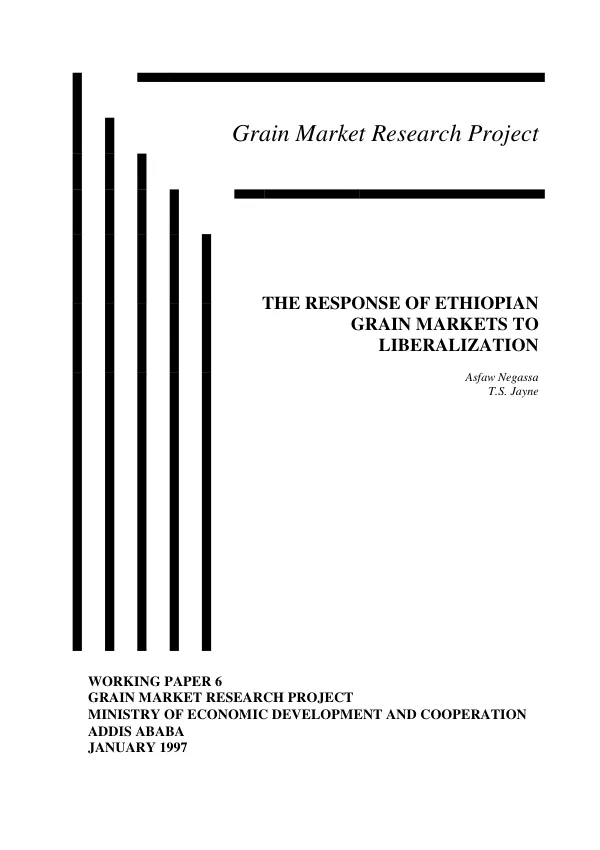
Effect of liberalization on grain prices and marketing margins in Ethiopia
Between 1990 and 1997, Ethiopia pursued a relatively consistent and internally driven program of grain market liberalization with the general approval of international lenders and donors.
Jayne, T. S. (Thomas S.); Negassa, Asfaw +1 more · 1970
Sign in to readA free account is required to download.
Abstract
This report uses descriptive indicators and a reduced-form econometric model to examine the effects of the reform on maize and teff prices and price spreads after controlling for exogenous factors such as rainfall, food aid distributed onto local markets, and seasonality. Maize and teff are the two most important traded grain commodities in Ethiopia. The model is estimated simultaneously across six markets using a seemingly unrelated regression estimator (SURE). Tests for unit roots in the data indicated that maize and teff prices were stationary in almost all cases, as were food aid and rainfall. The results generally indicated that grain market reform was associated with higher prices in major grain-producing areas and lower prices in major grain-deficit areas. Grain price spreads (the difference in wholesale prices between surplus and deficit markets) declined in 7 of 8 cases for maize and 10 of 11 cases for teff. Since marketing costs account for 40% to 60% of the price that consumers pay for staple cereal commodities in Ethiopia and throughout Africa, the reduction of these costs represents a major opportunity to improve both farm production incentives and household food security. Despite these positive developments, the grain marketing systems in Ethiopia and, more generally, in Africa continue to operate under numerous constraints that hamper the achievement of further gains in market efficiency. Moreover, the reforms in Ethiopia have not appreciably reduced grain price volatility. These findings are indicative of the growing empirical evidence that, while policy reforms have often been critical in reducing costs and risks to farmers, marketing actors, and consumers, they must be viewed as part of a broader program of market growth that involves the development of key market institutions, infrastructure, contract law and enforcement, and the general nurturing of civil society. (Author abstract, modified)