MICHIGAN STATE UNIVERSITY
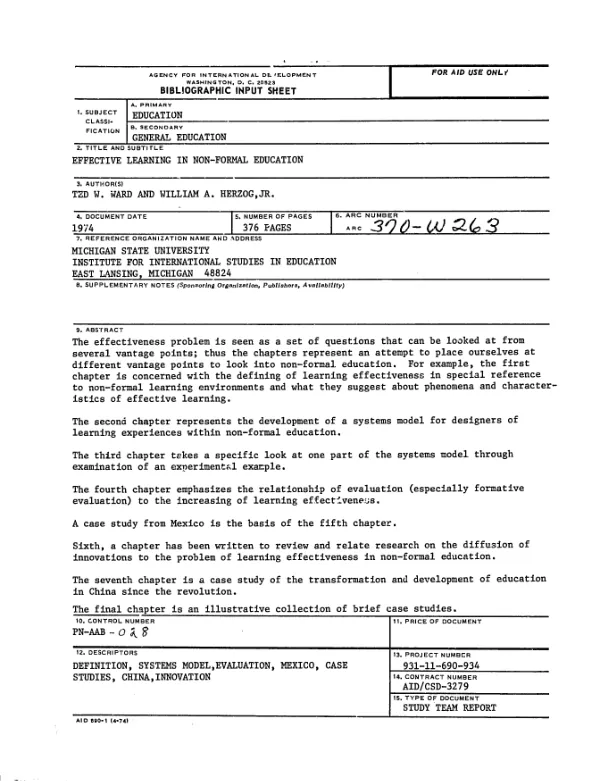
Effective learning in non-formal education
The effectiveness problem is seen as a set of questions that can be looked at from several vantage points; thus the chapters represent an attempt to place ourselves at different vantage points to look into non-formal education.
Ward, T. W.; Herzog, W. A. · 1970
Sign in to readA free account is required to download.
Abstract
For example, the first chapter is concerned with the defining of learning effectiveness in special reference to non-formal learning environments and what they suggest about phenomena and characteristics of effective learning. The second chapter represents the development of a systems model for designers of learning experiences within non-formal education. The third chapter takes a specific look at one part of the systems model through examination of an experimental example. The fourth chapter emphasizes the relationship of evaluation (especially formative evaluation) to the increasing of learning effectiveness. A case study from Mexico is the basis of the fifth chapter. Sixth, a chapter has been written to review and relate research on the diffusion of innovations to the problem of learning effectiveness in non-formal education. The seventh chapter is a case study of the transformation and development of education in China since the revolution. The final chapter is an illustrative collection of brief case studies.
Connected topics