USAID DEC
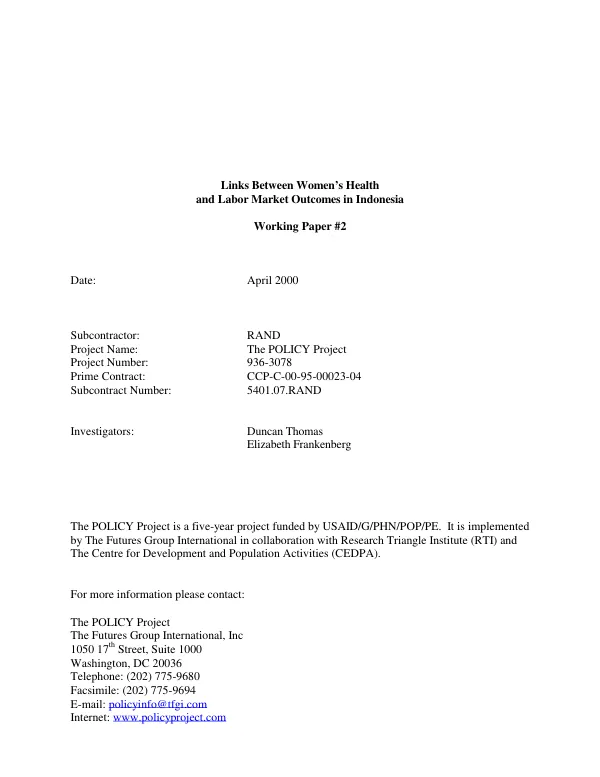
Effects of access to health services on adult health status : evidence from Indonesia"s "midwife in the village" program
Sign inCENTRE FOR DEVELOPMENT AND POPULATION ACTIVITIES (CEDPA)
Effects of access to health services on adult health status : evidence from Indonesia"s "midwife in the village" program
In the early 1990s the Government of Indonesia began a program to train midwives and place them in villages and townships throughout the country.
Thomas, Duncan; Frankenberg, Elizabeth · 2000
Sign in to readA free account is required to download.

Abstract
The village midwife program was implemented to address concerns about the maternal mortality rate and also as a general means of increasing access to health services, particularly for women and children. Using data from two rounds of the Indonesia Family Life Survey (IFLS), this report documents a substantial increase over time in access to village midwives. Between 1993 and 1997, the fraction of IFLS communities with a village midwife increased from 10% to almost 45%. Examination of the relationship between community-level health status and socioeconomic development in 1993 and whether a community gained a village midwife by 1997 suggests that communities where nutritional status and level of infrastructure in 1993 were relatively low were particularly likely to gain a village midwife by 1997. The report addresses the issue of non- random placement of midwives by using statistical models to examine change in health status -- measured in terms of body mass index (BMI), a standard measure of adult nutritional status -- as a function of whether the community gained (or lost) a village midwife. On average, the BMI of adults in Indonesia increased between 1993 and 1997. Regressions of change in BMI as a function of change in access to a village midwife show that for women under 50, increases in BMI were significantly more likely among those who lived in communities that gained a village midwife. Gaining a village midwife appears to have had no impact on men"s health status or on the health status of women over 50 as a group. Among women under 50, the largest effects of gaining a village midwife on BMI are observed for women in the lower quartile of the BMI distribution in 1993, for relatively younger women, and for women with relatively more education. In combination, the results suggest that efforts of the Ministry of Health to rapidly expand access to midwifery services has had a payoff in terms of the health status of women of reproductive age. Includes references. (Author abstract, modified)