USAID DEC
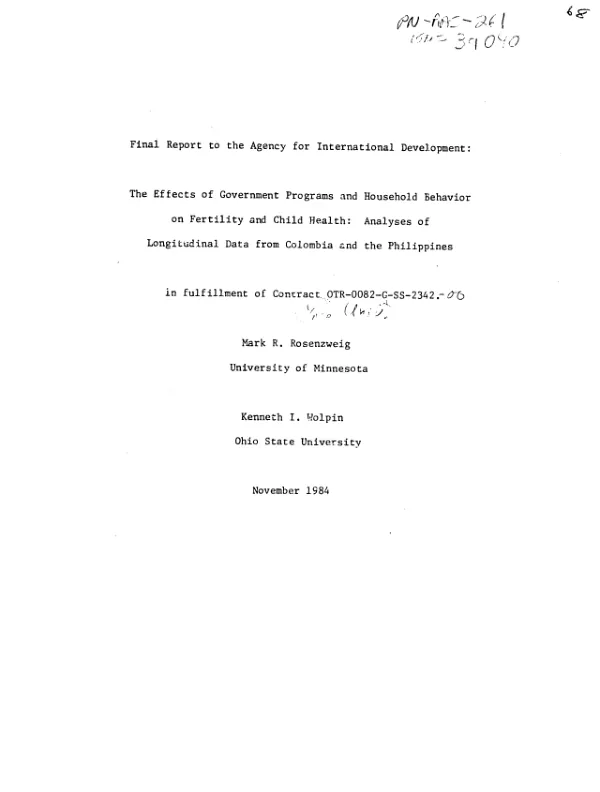
Effects of government programs and household behavior on fertility and child health : analyses of longitudinal data from Colombia and the Philippines
Sign inYALE UNIVERSITY
Effects of government programs and household behavior on fertility and child health : analyses of longitudinal data from Colombia and the Philippines
Three econometric studies are presented which use longitudinal, micro data to show that almost all prior studies evaluating the effects of government programs and of parental behavior on child health have ignored important differences among households, and for this reason have probably produced biased and potentially misleading results.
Rosenzweig, Mark R.; Wolpin, Kenneth I. · 1984
Sign in to readA free account is required to download.
Abstract
The first study develops a dynamic model of household resource allocation which incorporates two previously neglected factors - differing characteristics among individual children and parents" uncertainty, prior to a child"s birth, as to that child"s characteristics. The study concludes that previous researchers have understated importantly the effects of birth order and birth spacing on child health while overstating the effects of breastfeeding. Data were derived from a 1968-74 Promotora survey in Candelaria, Colombia. The second study uses data on the selective migration of low-health households to Candelaria to demonstrate previously unobserved positive effects on child health of the Promotora program itself. The third study evaluates health and family planning programs in Laguna, the Philippines, showing that the positive and significant child health effects of both programs are obscured when account is not taken of the systematic associations between program placement and the health status of targeted localities. The implications of the three studies for data collection are discussed.
Connected topics