USAID DEC
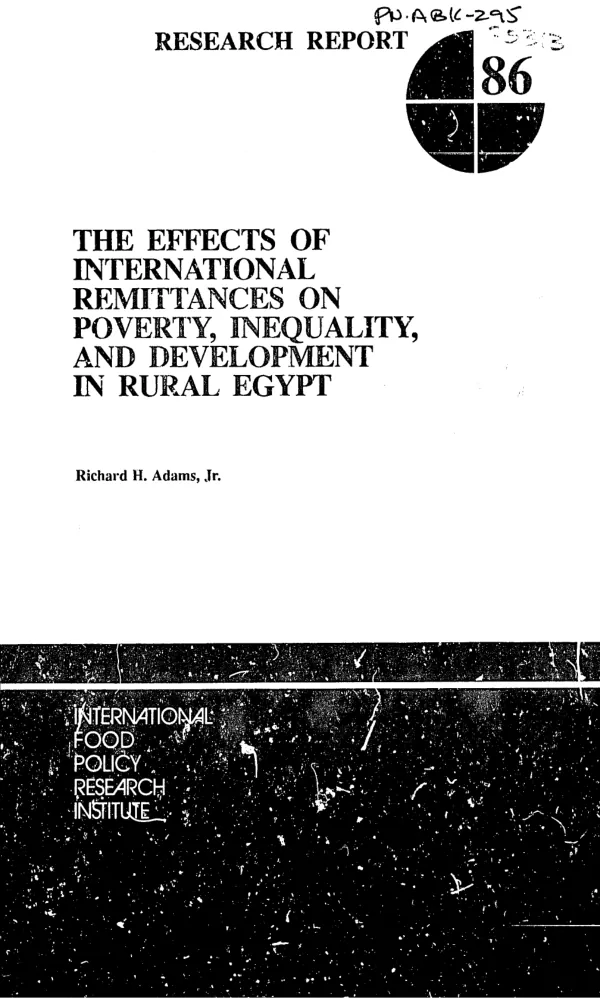
Effects of international remittances on poverty, inequality, and development in rural Egypt
Sign inINTERNATIONAL FOOD POLICY RESEARCH INSTITUTE (IFPRI)
Effects of international remittances on poverty, inequality, and development in rural Egypt
International remittances -- the money and goods transmitted to households back home by migrant workers -- can have a profound effect on poverty, income distribution, and development in rural areas of Third World countries.
Adams, Richard H., Jr. · 1991
Sign in to readA free account is required to download.
Abstract
This study examines the effects of international remittances on rural Egypt, where migration, primarily to neighboring oil-producing countries, has been extensive in recent years. Research involved a household survey conducted in 1986/87 in three villages in Minya Governorate, a rural province about 250 km south of Cairo. In this area, 339 out of 1,000 households surveyed had sent someone to work abroad in the past 10 years. For the migrant households, remittances accounted for 30.4% of total actual gross income. Findings indicate that international remittances have a small but positive effect on poverty, while the impact on income distribution is unclear. Contrary to popular belief, the data show that returned migrants do not devote large shares of their remittance earnings to personal consumption. Instead, migrant households tend to use these earnings for investments, such as housing, land, or small businesses. Includes bibliography.
Connected topics
Related documents