USAID DEC
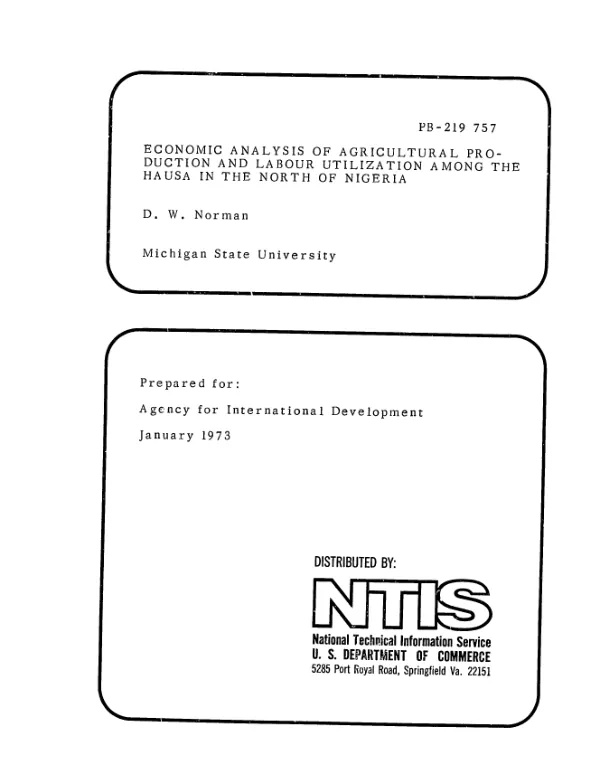
Effects of taxes and subsidies on land and labour utilization in Nigerian agriculture
Sign inMICHIGAN STATE UNIVERSITY
Effects of taxes and subsidies on land and labour utilization in Nigerian agriculture
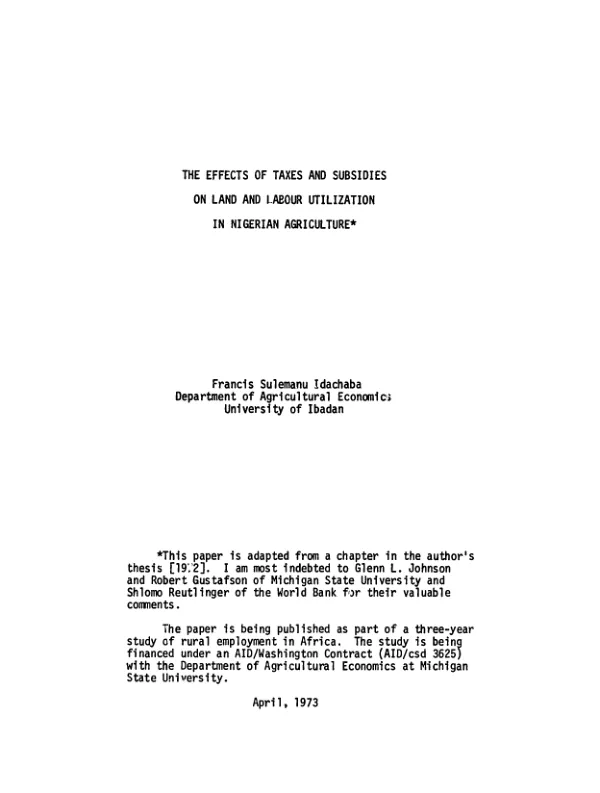
The major objective of Idachaba"s paper is to provide a theoretical framework for examining the effects of government and marketing board taxes on land and labor utilization in Nigerian agriculture.
Idachaba, Francis S. · 1970
Sign in to readA free account is required to download.
Abstract
The author develops a multicrop production function model along the lines of G.L. Johnson"s investment-disinvestment theory to analyze the effects of taxes on resource allocation. The model is extended to consider ways in which the allocative distortions from taxation might be minimized, in particular through subsidies on agricultural inputs. Empirical results on the effects of marketing board groundnut and cotton taxes on the rela (relative) prices of land and labor employed in these crops in the northern states of Nigeria are presented for the period 1950-1966. Idachaba concludes that taxes on these crops have resulted in: (a) a reduction in the rate of entry of new and young farmers and additional land into Nigerian agriculture and (b) an increase in the rate of exit of resources, both land and labor, from the Nigerian farm sector.
Connected topics