USAID DEC
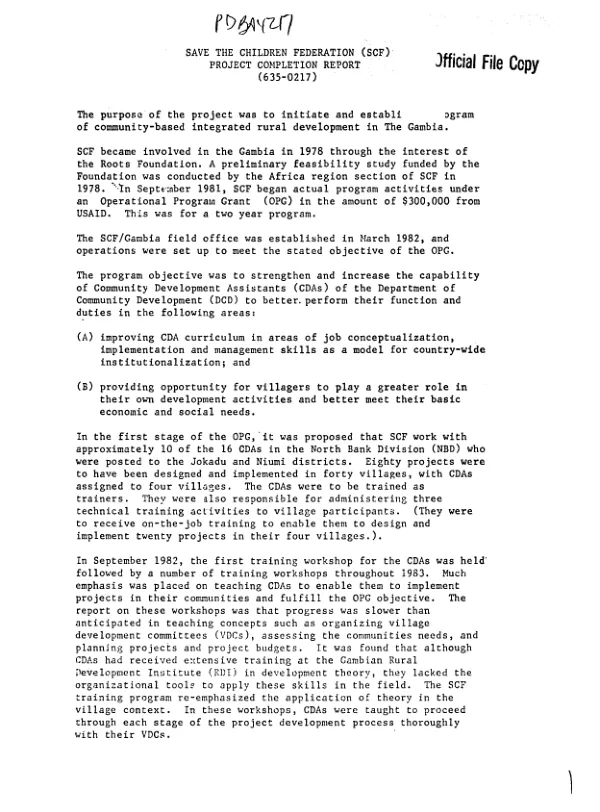
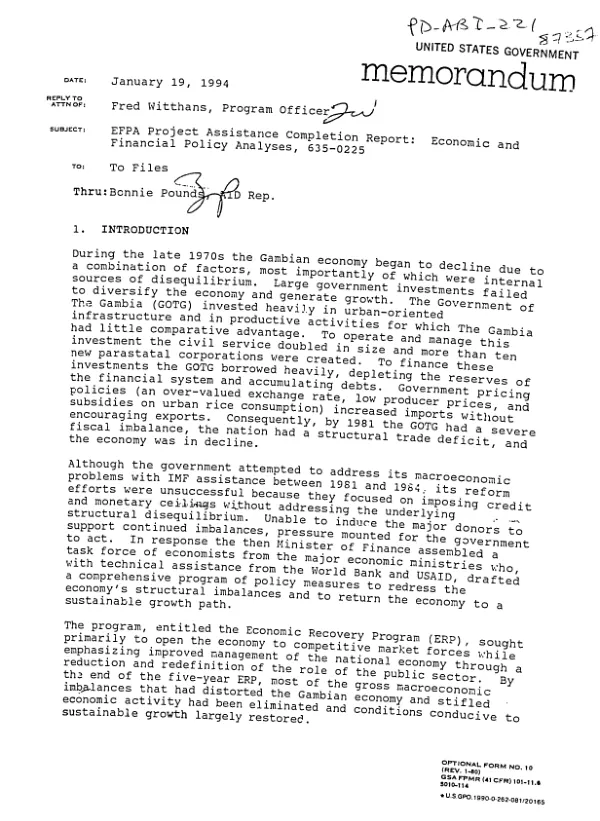
EFPA project assistance completion report : economic and financial policy analyses, 635-0225
Sign inUSAID. MISSION TO THE GAMBIA
EFPA project assistance completion report : economic and financial policy analyses, 635-0225
PACR of a project (6/84-11/92) to increase the capacity of the Government of The Gambia's (GOTG) Ministry of Finance and Economic Analysis (MFEA) to conduct economic and financial policy analyses.
Witthans, Fred · 1994
Sign in to readA free account is required to download.
Abstract
The project was implemented by Harvard Institute for International Development (HIID). The project was highly visible and performed well in a crisis management mode in its early years, during implementation of The Gambia's Economic Recovery Program (ERP). Its success was partly due to the personalities and strong convictions of the MFEA Minster and the HIID Chief of Party at the time. However, the style of these individuals and the pressures of crisis management meant that few others were involved in the process and little capacity was built. As planned, the project established the Macroeconomic and Financial Analysis Unit (MFAU), a semiautonomous unit within the MFEA, and the MFAU became critical to monitoring IMF program targets. Twelve policy studies were conducted by HIID advisors, with some participation from MFAU economists, and a major review of the tax system, also performed by HIID, is being used as a basis for administrative and policy reforms. HIID advisors were extremely influential in developing the ERP and in its implementation. The training program was deficient in that its focus was not on helping the MFEA to develop macroeconomics and financial policy analysis skills, its trainee selection process was arbitrary, and it failed to provide Ph.D.-level training. Only 20% of long-term trainees, and 50% of short-term trainees were from the MFEA. However, seminars and workshops for senior policymakers were successful in raising awareness of national economic matters. So far as institution building is concerned, the project was only partially successful. MFAU staff turnover was high (many trainees took positions with other government agencies or with the private sector), and by the end of the project the MFAU was understaffed. Thus, after 6 years of operation, the MFAU effectively does not have any staff who benefited from the project and has only a minimal capacity to continue producing economic and financial analysis and statistics. The MFAU's mandate was never clear -- neither MFEA nor HIID developed a term of reference for the Unit. As a result it was not operated as an integral part of the MFEA. The following lessons were learned. (1) An economic research and policy analysis unit cannot be institutionalized unless the unit becomes an integral part of the MFEA, has a clear mandate, has access to data through clearly established procedures, and is staffed according to employment policies that are competitive with the private sector. (2) Successful personnel development in a research and policy analysis project requires a master plan outlining needed staff skills, development of career paths, specification of skills transfer in expatriate advisors' terms of reference, development of incentive systems, and training of understudies when principal staff members are away for long-term training. (3) The capacity to conduct economic research and develop policy papers requires experience, which can be developed through conferences and peer review sessions at which Gambian researchers can present their work, collaborative studies by long-term expatriate consultants and Gambian researchers, choosing of policy analysts from senior civil service staff to enhance the retention of skilled personnel, and development of a Ph.D.-level cadre of economists.