USAID DEC
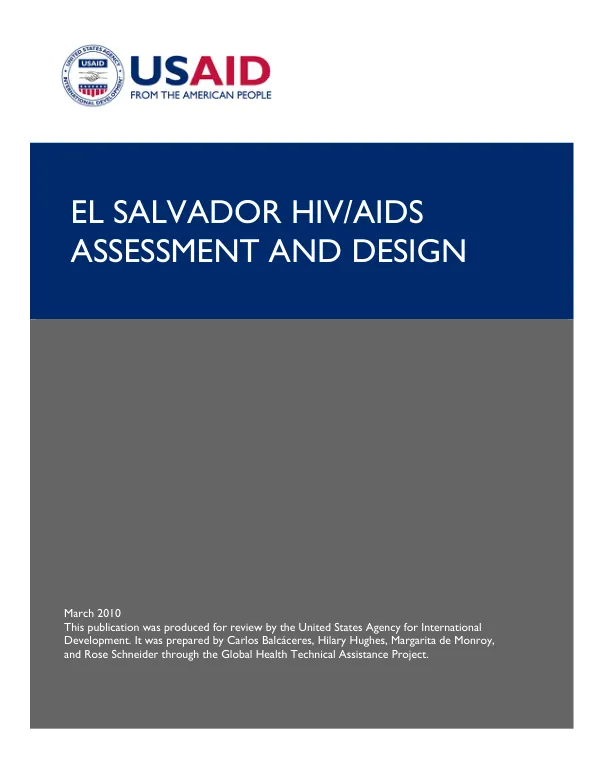
El Salavador HIV/AIDS assessment and design : recommendations for USAID support to the national HIV/AIDS response in El Salvador, 2010-1015
Sign inQED GROUP, LLC
El Salavador HIV/AIDS assessment and design : recommendations for USAID support to the national HIV/AIDS response in El Salvador, 2010-1015
This report covers advances, challenges, and recommendations for the following program areas: prevention, health systems strengthening, strategic information, and policy environment.
Balcaceres, Carlos; Hughes, Hilary · 2010
Sign in to readA free account is required to download.
Abstract
The assessment primarily focuses on prevention, given the nature of El Salvador"s concentrated HIV/AIDS epidemic and the national response to date (see Section I below). While HIV prevalence in the general population is less than 1%, far higher rates are found in men who have sex with men (MSM) (17.75%), sex workers (SWs) (3.6%), and female crack cocaine users (8.5%). Advances to date are largely clinical. The assessment recommends a paradigm shift in the national response toward prevention. This includes the need to expand behavior change communication (BCC) among most-at-risk populations (MARP) such as SWs and MSM; to bridge populations such as clients of sex workers and female partners of MSM; and to reach vulnerable groups such as youth, drug users (cocaine), and prisoners. Rapid expansion of prevention education will require equally rapid expansion of technical assistance and funds to multiple civil society organizations working closely with MARP and vulnerable populations at the provincial and community levels. Prevention also requires improving the quality of counseling in clinical settings and addressing the challenges in HIV/AIDS/sexually transmitted infection (STI) and tuberculosis (TB) testing and treatment which continue to fuel the spread of HIV (see Health Systems Strengthening, Section III). In order to ensure that the quality and coverage of prevention efforts are adequately monitored and evaluated, recommendations include the importance of involving civil society implementers in the country"s Unified System of Monitoring, Evaluation, and Epidemiological Surveillance (known as its Spanish acronym SUMEVE). Due to its limited funds, USAID"s support to the national program should go beyond financial assistance; recommendations therefore target areas that require leverage and advocacy rather than funds. (Author abstract, modified)
Related documents

![Impact assessment of HIV/AIDS on the Municipalities of Ongwediva, Oshakati, Swakopmund, Walvis Bay and Windhoek[, Namibia] -- [final report] volume 4 : Swakopmund](https://covers.devme.ai/gen/57975.webp)
![Impact assessment of HIV/AIDS on the Municipalities of Ongwediva, Oshakati, Swakopmund, Walvis Bay and Windhoek[, Namibia] -- [final report] volume 5 : Walvis Bay](https://covers.devme.ai/gen/57974.webp)