THAILAND. DEPT. OF TECHNICAL AND ECONOMIC COOPERATION
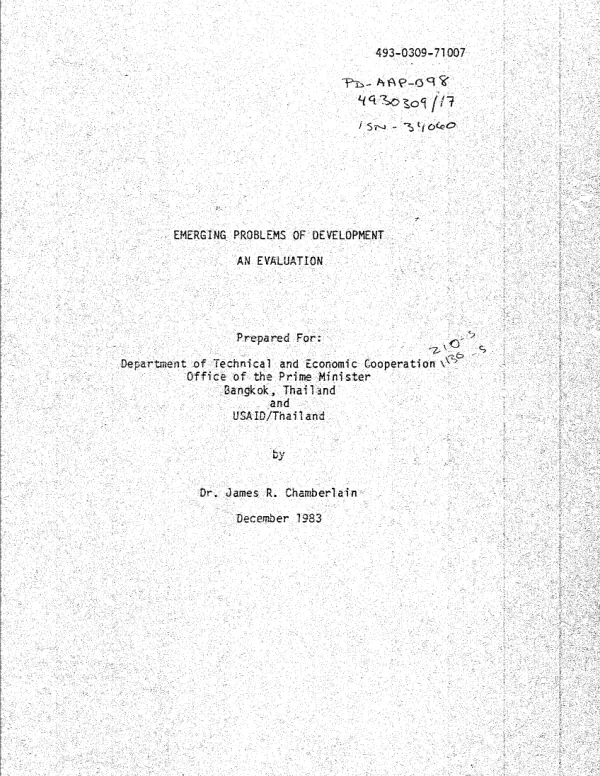
Emerging problems of development : an evaluation
Evaluates project to strengthen the Royal Thai Government"s (RTG) capability to address key development needs.
Chamberlain, James R. · 1983
Sign in to readA free account is required to download.
Abstract
Midterm special evaluation covers the period 8/80-12/83 and is based on document review and interviews with project personnel and trainees. Despite its short existence, the project, being implemented by the Department of Technical and Economic Cooperation (DTEC) and USAID/T, has had a remarkable impact - introducing high technology (for which the United States has clearly emerged as a primary source), promoting coordination among RTG agencies, and supporting the latter"s capacity to carry out development activities on their own. Currently, the project is providing TA to l5 RTG agencies. Assistance has led to policy and planning reforms at the National Economic and Social Development Board (NESDB), the Bureau of Budget, the Office of the Auditor General, and the Comptroller General"s Department. An urbanization and transport study has helped lay the basis for a project to solve Bangkok"s mass transportation problems, while technical surveys and recommendations on pollution problems at the National Environment Board led to installaton of an air pollution monitoring systemn in Metropolitan Bangkok. In addition, U.S., in-country, and third-country training has been given or is being planned for over 150 RTG personnel. On the negative side, the project has lacked systematic follow-up to identify activities most likely to successfully replicated, and considerable delays have been caused by AID/W inefficiency in identifying TA and training resources. Recommendations are, inter alia, that: the DTEC immediately prepare for the expanded follow-up project being contemplated (including preparing guidelines for consultants and establishing a representative at the Thai embassy in Washington, D.C. to help identify consultant and training institutions); the analytically highly capable NESDB play a greater role in problem identification, especially in clarifying guidelines for national 5-year plans; and that in order to obviate brain drain, participant training focus on civil service personnel who are required to return to their former positions.