USAID DEC
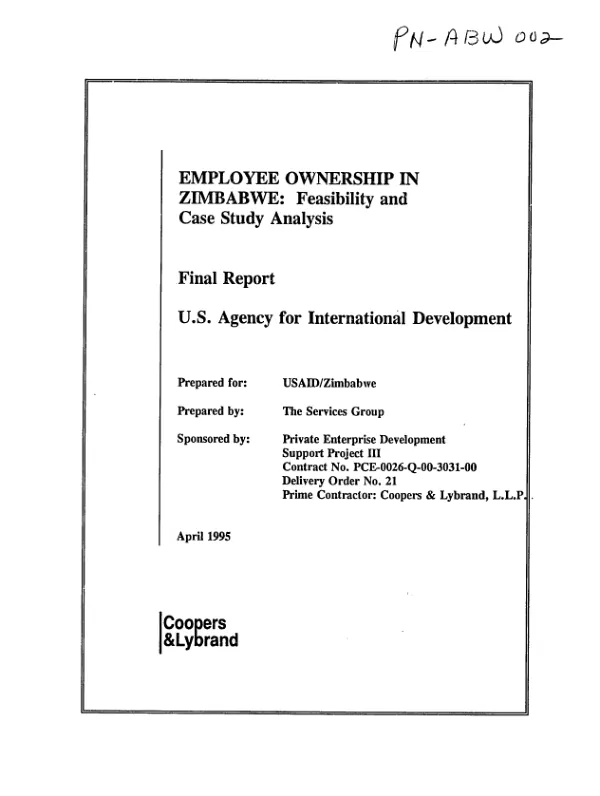
Employee ownership in Zimbabwe : feasibility and case study analysis -- final report
Sign inCOOPERS AND LYBRAND
Employee ownership in Zimbabwe : feasibility and case study analysis -- final report
There is a significant, if limited, base of experience with employee ownership in Zimbabwe, usually structured either as employee trusts, with a small shareholding spread broadly among employees, or as direct employee ownership, usually concentrated on a select group of employees, such as management.
Fell, Greg; Hoffmire, John · 1995
Sign in to readA free account is required to download.
Abstract
This report analyzes employee ownership in Zimbabwe, using three case studies, and proposes an Employee Stock Ownership Plan (ESOP) model. Following an introduction, Section 2 reviews the economic, legal, and financial framework, as well as policy and institutional requirements for ESOPs. Section 3 proposes an employee ownership trust as an ESOP model and delineates the model"s structure, funding, tax provisions, external financing, dilution, governance, and motivation of stakeholders. Section 4 applies the model to three Zimbabwean companies -- Delta Corporation, Rio Tinto Zimbabwe Limited, and Art Corporation -- proving it to be a workable vehicle for employee ownership plans, and a potential mechanism for expanded ESOPs. Section 5 examines the social context for ESOP formation (more fully examined in an appendix) as well as the microeconomic and macroeconomic impact of ESOPs; it is noted that black and female Zimbabweans, who have the least access to formal sector employment, are also least likely to participate in ESOPs. Section 6 presents conclusions and recommendations. General recommendations are to: develop an ESOP tax model and constituencies within the public and private sectors, implement tax incentives supportive of ESOPs, link privatization to ESOPs, utilize Loan Guarantee Programs to stimulate financing for ESOPs, and support establishment of an ESOP Trade Association. Specific recommendations for USAID interventions are made as well.