USAID. BUR. FOR PRIVATE ENTERPRISE
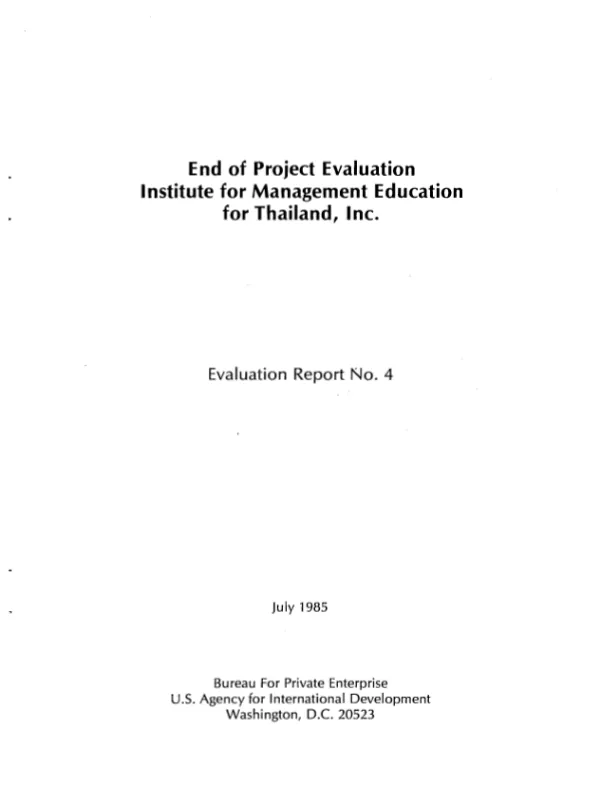
End of project evaluation Institute for Management Education for Thailand, Inc.
Provides final report (9/82-7/85) on project to strengthen Thailand's private sector by establishing an Institute for Management Education for Thailand (IMET).
Bell, John A.|Murray, F. T. · 1985
Sign in to readA free account is required to download.
Abstract
The IMET has been established and is carrying out programs through four institutions: Thai Management Association (TMA), Thammasat University, National Institute of Development Administration (NIDA), and Chulalongkorn University. A flexible project design allowed the IMET to successfully shift its priority from business school faculty and mid-level managers to to owner-entrepreneurs of rural businesses. The response has been striking; participant contributions of close to $1,000 per seminar have helped IMET meet the grant's matching fund requirement. The new management approaches have already had an impact at the micro-economic level - sales increases as high as 300% and inventory reductions of 35% have been verified. The IMET has strengthened its in-house structure by reorganizing the Board of Directors, hiring a full-time manager, and developing a corporate plan. University faculty have appreciated the opportunity to adopt a new role in taking management education out to rural businessmen, and this has in turn had a positive influence on their classroom teaching. However, they were insufficiently prepared to work in a non-academic situation. Despite the growing numbers of participant contributions, the IMET is not yet self-sustaining due to competition in securing tax-deductible corporate contributions. All programs are suspended pending a decision on the IMET's proposal for funds from the Bureau for Private Enterprise (PRE). Overall, the project's results, many of them unforeseen, indicate the replicability of its flexible design. The project taught: (1) the need of quantified output targets for project evaluation; (2) the advisability of preparing a Project Implementation Letter even in small projects in order to clear up discrepancies between the Project Proposal and the Program Description and avoid delays in funding; and (3) the advisability of having the project officer reside in the A.I.D. mission rather than in Washington, D.C.
![Extending successful hospital-based child survival strategies into surrounding urban, peri-urban, and rural communities of Boaco, Nicragua : CS-VII [child survival], grant no. PDC-0500-G-00-1064-00 -- final evaluation, September 1991-February 1995](https://covers.devme.ai/gen/5755.webp)
![Extending successful hospital-based child survival strategies into surrounding urban, peri-urban, and rural communities of Boaco, Nicragua : CS-VII [child survival], grant no. PDC-0500-G-00-1064-00 -- final evaluation, September 1991-February 1995](https://covers.devme.ai/gen/16761.webp)