USAID DEC
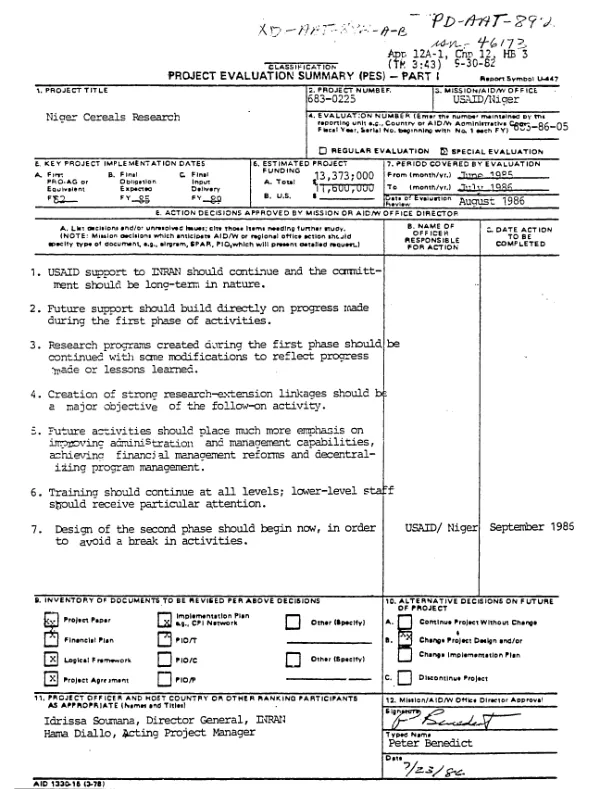
End of project evaluation of Partners of the Americas, grant no. LAC-0003-G-SS-5125-00 : Central America regional strengthening democracy
Sign inMANAGEMENT SYSTEMS INTERNATIONAL, INC. (MSI)
End of project evaluation of Partners of the Americas, grant no. LAC-0003-G-SS-5125-00 : Central America regional strengthening democracy
Final evaluation of a project to strengthen democratic leadership in Central America by establishing educational and technical linkages between six Central American countries and six U.S.
1989
Sign in to readA free account is required to download.
Abstract
states. External evaluation covers the period 9/85-7/89, and focuses on the following partnerships: Costa Rica-Oregon, Guatemala-Alabama, Honduras-Vermont, and Panama-Delaware. The project, implemented by the National Association of Partners of the Americas (NAPA), had a positive impact on public and private democratic and community institutions in Central America. These institutions have benefited from training, access to valuable materials and professional resources, enrichment of activities and programs, and funding for administrative staff and operating expenses. The grant also resulted in strengthened democratic leadership and participatory processes at the community level and important linkages between U.S. and Central American institutions and individuals. These benefits accrued even though none of the leaderships of the partnerships had any knowledge of the specific objectives of the NAPA grant. Regional planning seminars provided an informal opportunity for partnership leaders to exchange information, ideas and experiences, and to develop annual plans for more efficient resource use, better programming, and improved communication between the committees. Seminars on specific topics were a useful introduction to the subject matter, but there was an expressed need for more intensive follow-up TA and training in fundraising and volunteerism. One of the partnerships reviewed successfully established a balanced geographic decentralization in the form of city-to-city linkages, resulting in broader public support, distribution of the administrative burden among several groups, and easier fundraising. The other partnerships have been unable to solve the practical obstacles to such decentralization, though they consider it a desirable goal. While NAPA is providing a large range of technical services to the partnerships, there is a need to strengthen the quality as well as the quantity of TA, particularly in the area of organizational development. NAPA"s minimum 10-day travel requirements resulted in the loss of expert TA for some projects, since many professionals cannot leave their responsibilities for that length of time. While the partnerships have made strides in raising funds for specific programs, they are not financially self-sufficient in terms of operating costs and most lack the fundraising strategies and income-generating capabilities necessary to become so. It is recommended that future financial support for the program be conditioned on the establishment of plans for financial self-sufficiency within a certain time period.
Related documents

![Activity completion report -- Guatemala-Central America programs : [Hurricane] Mitch special objective : improved regional capacity to mitigate transnational effects of disasters (596-004)](https://covers.devme.ai/gen/5432.webp)