CREATIVE ASSOCIATES INTERNATIONAL INC.
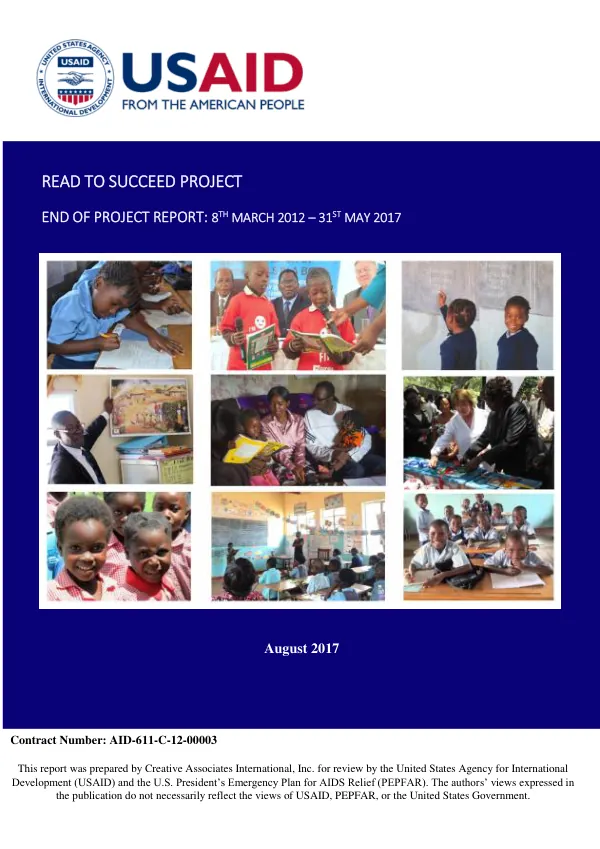
End of Project Performance Report: Read to Succeed Project
The USAID Zambia Read to Succeed Project was a five-year initiative aimed at improving reading skills among primary school students in Zambia.
2017 · 60 pages
Sign in to readA free account is required to download.
Abstract
The project, which began on March 8, 2012, and concluded on May 31, 2017, was implemented by Creative Associates International, Inc. under contract number AID-611-C-12-00003. The project's main objective was to improve reading skills among primary school students, with a focus on teacher effectiveness, assessment tools, HIV/AIDS prevention, and engagement of Zambian institutions of higher education in educational research. The project was implemented in various districts across Zambia, with a focus on improving teacher accountability, promoting education leadership and management, and strengthening school effectiveness. One of the key components of the project was the implementation of decentralized education management practices to improve teacher accountability and sustain learner performance. This involved strengthening teacher effectiveness through continuous professional development (CPD) and accountability for reading skills, promoting education leadership and management for head teachers and senior managers, and establishing a school effectiveness improvement process in schools and districts. The project also focused on promoting the use of assessment tools, including the Early Grade Reading Assessment (EGRA), to improve teaching reading skills. This involved strengthening assessment policies, strategies, and procedures, expanding and improving assessment instruments, and effectively using assessment data by districts, schools, and communities. In addition, the project aimed to prevent HIV/AIDS through a continuum of guidance and counseling support services for learners, especially girls. This involved harmonizing school health policies and implementation frameworks, operationalizing school guidance and counseling systems, and strengthening school-community partnerships. The project also engaged Zambian institutions of higher education in educational research, with a focus on universities and colleges research networks, research internship programs, and universities/higher education institutions engaged in research activities. The project's monitoring and evaluation (M&E) framework was designed to track progress and assess the effectiveness of project interventions. This involved conducting data quality assessments (DQA), strengthening M&E practice in the Ministry of General Education (MOGE), routine data analysis, progress review, and reporting, and implementing longitudinal studies. The project faced several challenges, including coordination and harmonization, delays in production of materials, public funding, high deployment transfers, lack of incentives for additional responsibilities, and class size. Despite these challenges, the project made significant progress in improving reading skills among primary school students, with notable gains in teacher effectiveness, assessment tools, HIV/AIDS prevention, and engagement of Zambian institutions of higher education in educational research. The project's sustainability was a key concern, and several recommendations were made to ensure the continuation of project interventions. These included steps to sustain material production, CPD, teacher group meetings, and other project activities. The project's lessons learned and challenges faced were also documented, providing valuable insights for future projects and initiatives.
Related documents