USAID DEC
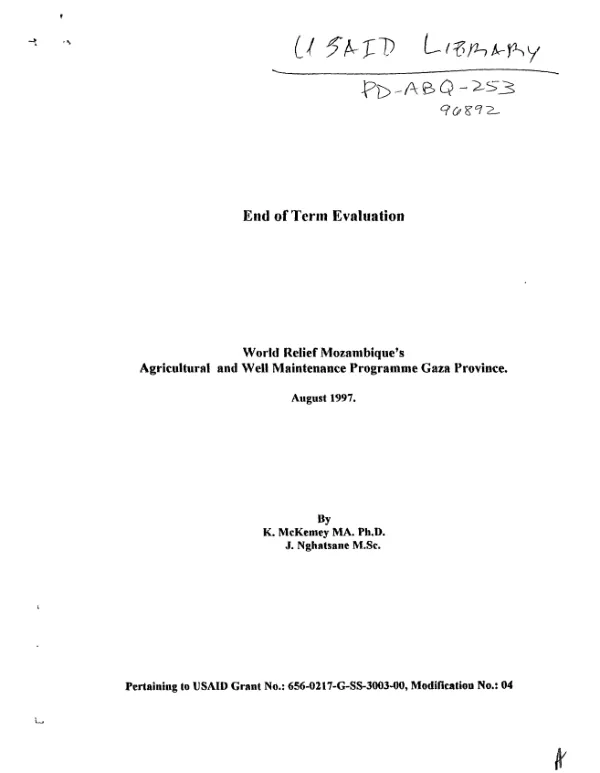
End of term evaluation : World Relief Mozambique"s agricultural and well maintenance programme Gaza Province
Sign inUSAID. MISSION TO MOZAMBIQUE
End of term evaluation : World Relief Mozambique"s agricultural and well maintenance programme Gaza Province
Final evaluation of a project (10/95-9/97) implemented by World Relief (WR) to improve incomes and food security in targeted areas of Chicualacuala, Guija, Mabalane, Chigubo, and Massangena in Gaza Province, Mozambique.
McKemey, K.; Nghatsane, J. · 1997
Sign in to readA free account is required to download.
Abstract
The project included activities in four major areas: agricultural extension; livestock improvement and multiplication; crop diversification and improvement; and maintenance of the wells and pumps previously established by WR with USAID support. Although tight control over expenditures and WR"s failure to match certain parts of the program prevented WR from fulfilling all of the grant"s provisions, the project has achieved most of the expected outcomes set in the current grant amendment and made a significant contribution to the food security and economy of many rural households within the targeted area. The group extension model adopted, as well as the education and services provided, proved very effective. The extension training and services have led to a significant overall improvement and growth of the small livestock population and, to a lesser degree, to improvements in local crop husbandry practices. However, WR has also continued to provide free distribution of cereal and vegetable seeds, which tends to conflict with the more developmental (cost-recovery) approach promoted by the grant program. Only one of the project"s interventions -- the introduction and/or redistribution of root crops, cassava, and sweet potato -- can be considered sustainable. This achievement is considered to have had the single most important impact on sustainable food security of WR"s initiatives in Northern Gaza. Unfortunately, the veterinary service, specifically, poultry vaccination, and the well maintenance program, the two services on which much of the region"s human and animal welfare now depend, are currently not locally sustainable. The conclusion is that WR should attempt to maintain these two services for a year given the current failure to identify any alternative structures capable undertaking these roles. If left unattended, many of the current achievements in both human and livestock health will be put at risk. WR"s primary objective must be the development of local linkages and the identification of local counterparts to sustain the projects. (Author abstract, modified)
Related documents
Documents in this collection
 1997
1997USAID DEC
End of term evaluation : World Relief Mozambique's agricultural and well maintenance programme Gaza Province
Open record![Final evaluation of 'emergency program to assist the vulnerable people in Liban [i.e Liben] Woreda, Borena Zone of Oromia Regional State [and] Filtu Woreda, Liben Zone of Somali Regional State'](https://covers.devme.ai/gen/5421.webp) 2002
2002USAID DEC
![Final evaluation of "emergency program to assist the vulnerable people in Liban [i.e Liben] Woreda, Borena Zone of Oromia Regional State [and] Filtu Woreda, Liben Zone of Somali Regional State"](https://covers.devme.ai/gen/44245.webp)