USAID DEC
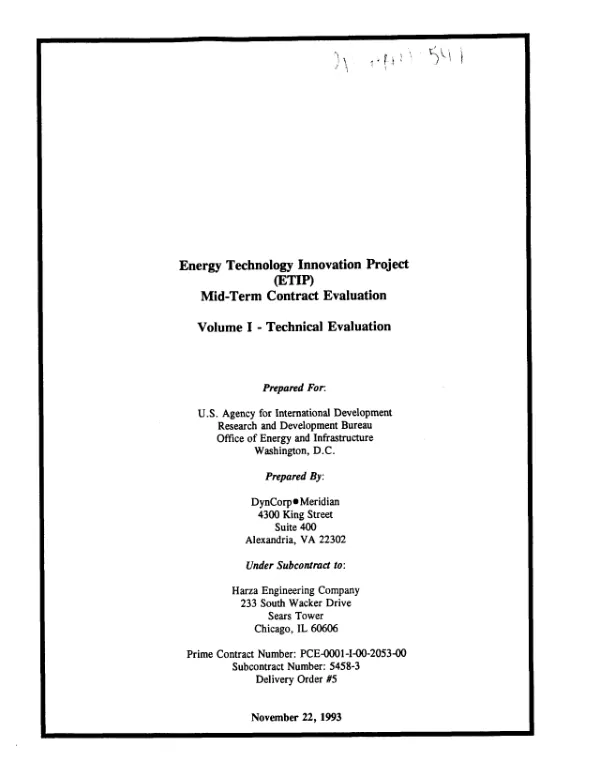
Energy technology innovation project (ETIP) : mid-term contract evaluation -- volume I - technical evaluation
Sign inDYNCORP-MERIDIAN
Energy technology innovation project (ETIP) : mid-term contract evaluation -- volume I - technical evaluation
Evaluates Energy Technology Innovation Project (ETIP), which promotes the use of clean and efficient U.S.
Franke, J.|Cosgrove-Davies, M. · 1993
Sign in to readA free account is required to download.
Abstract
energy technologies in the electric power sectors of developing countries. Mid-term evaluation covers the period 8/91-11/93. ETIP is providing critical, relevant, and desired services within the defined scope of activities, and should make substantial progress in introducing innovative and environmentally benign energy technologies in the developing world, but needs to take more proactive action. In order to make a real and sustainable change in the energy decisions of the developing world, ETIP will need to develop a comprehensive strategy with a committed long-term approach. Bechtel has performed well and should continue to serve as contractor. Instead of actively pursuing a global strategy, ETIP has become predominantly reactive in nature, its staff and resources largely being used for quick-response activities in the New Independent States (NIS). Though these projects address critical needs, they limit the resources available for other activities. Work in the NIS is being phased out though, as the NIS Task Force is securing its own energy contractor, and ETIP will soon move to a new phase of operation. Neither Bechtel nor USAID officials have a clear vision of how ETIP will proceed. It is recommended that ETIP develop a proactive strategy and focus on introducing specified changes in a limited number of countries -- particularly those which have a potentially large impact on global environmental well-being, and those that have a large and growing energy demand and are important to the United States for other foreign policy or economic reasons. Due to the time-consuming nature of NIS activities, no strategy has been implemented to encourage private sector involvement in ETIP. Nor is there any means other than contractor goodwill to transfer lessons learned to the U.S. private sector seeking to enter new energy markets. USAID feels that there are not enough activities in the pipeline to sustain the project once NIS activities are taken over by a dedicated contractor. Bechtel feels otherwise, but believes it is the Project Officer's responsibility to take the lead in marketing ETIP services. It is recommended that Bechtel not be reluctant to market ETIP's services. There do in fact seem to be a number of untapped opportunities; unfortunately, there are not (and are not soon likely to be) sufficient travel funds to allow the Project Officer to promote ETIP to the Missions. Better packaging of the project, e.g., providing Missions with a summary of ETIP's scope of work, experiences in developing countries, lists of projects completed, capabilities of subcontractors, and examples of services available. Generally, Missions are satisfied that ETIP activities have been However, in at least one case (Armenia) there was a sense that valuable funds were being used to analyze a problem that was already well understood and documented. Mission officials want greater control and interaction with the contractors working in-country on buy-in projects. This arrangement has caused some frustration and has reduced the attractiveness of the buy-in mechanism to several Missions. The problem can be overcome by establishing formal communication channels prior to initiation of Mission-level activities and by keeping Missions apprised of ETIP buy-in activities. ETIP has developed positive cooperative relationships with numerous organizations and institutions, including other USAID projects, the World Bank, and the Inter-American Development Bank. Increased cooperation with trade organizations and continued exploration of cost-sharing and collaboration are recommended.
![Evaluation of the US-Asia environmental partnership [US-AEP]](https://covers.devme.ai/gen/5422.webp)