MERCY CORPS INTERNATIONAL
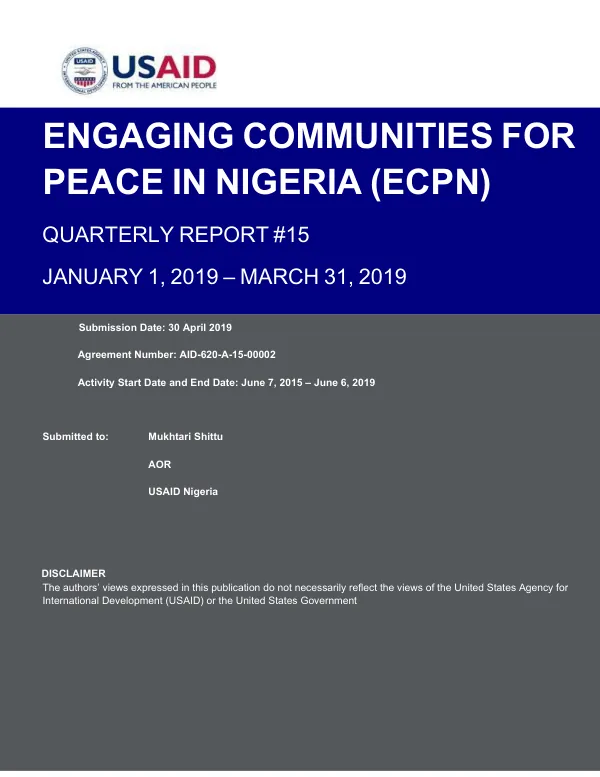
Engaging Communities for Peace in Nigeria (ECPN) Quarterly Report #15
Engaging Communities for Peace in Nigeria (ECPN) is a project that aims to reduce violence between farmers and pastoralists in Nigeria's Middle Belt states.
2019 · 30 pages
Sign in to readA free account is required to download.
Abstract
The project began on June 7, 2015, and is set to end on June 6, 2019. The project is implemented by Mercy Corps, with Pastoral Resolve as a sub-awardee, and is funded by the United States Agency for International Development (USAID) under the contract number AID-620-A-15-00002. The project's key focus areas include expanding the work under the current project, addressing USAID's request to incorporate conflict mitigation across sectors, and selecting and building the capacity of influential Civil Society Organizations (CSOs) in the Northeast to help them address divisions within communities, promote mutual understanding, and support reconciliation processes. The project also aims to build the capacity of USAID Mission staff, sector implementing partners, and associated Nigerian CSOs in conflict and peacebuilding. The project has made significant progress in reducing violence between farmers and pastoralists. According to the project's indicators, the number of conflicts reported from activity interventions supported by USG funds decreased by 13.1% in the reporting period. The capacity of communities to resolve disputes increased, with 1,394 disputes resolved by trained participants, representing a 174.3% increase from the baseline. The project also reported a 224.3% increase in the number of local women participating in a substantive role or position in a peacebuilding process supported with USG assistance. The project has also made progress in increasing trust between communities across lines of division. According to the project's indicators, 30% of participants reported social cohesion across conflict group lines, representing a 21.0% increase from the baseline. The project also reported a 144% increase in the number of new groups or initiatives created through USG funding, dedicated to resolving the conflict or the drivers of the conflict. In addition, the project has made progress in developing joint community and government conflict management plans. According to the project's indicators, 93.0% of residents of USG-assisted communities were satisfied with the response to local conflicts by community conflict mitigation structures, representing a 93.0% increase from the baseline. The project also reported a 95.2% increase in the number of people participating in USG-supported events, trainings, or activities designed to build mass support for peace and reconciliation. The project has also made progress in developing the organizational and technical capacity of CSOs. According to the project's indicators, 89.2% of target CSOs had effective monitoring and evaluation systems as a result of USG-supported training or capacity building events, representing a 111.5% increase from the baseline. The project also reported a 63.6% increase in the number of CSOs receiving Mercy Corps assistance that improved internal institutional capacity as demonstrated by an increased Organizational Capacity Index (OCI) score. Overall, the ECPN project has made significant progress in reducing violence between farmers and pastoralists, increasing trust between communities, and developing joint community and government conflict management plans. The project has also made progress in developing the organizational and technical capacity of CSOs.
Related documents