BURNS AND ROE INDUSTRIAL SERVICES, CORP.
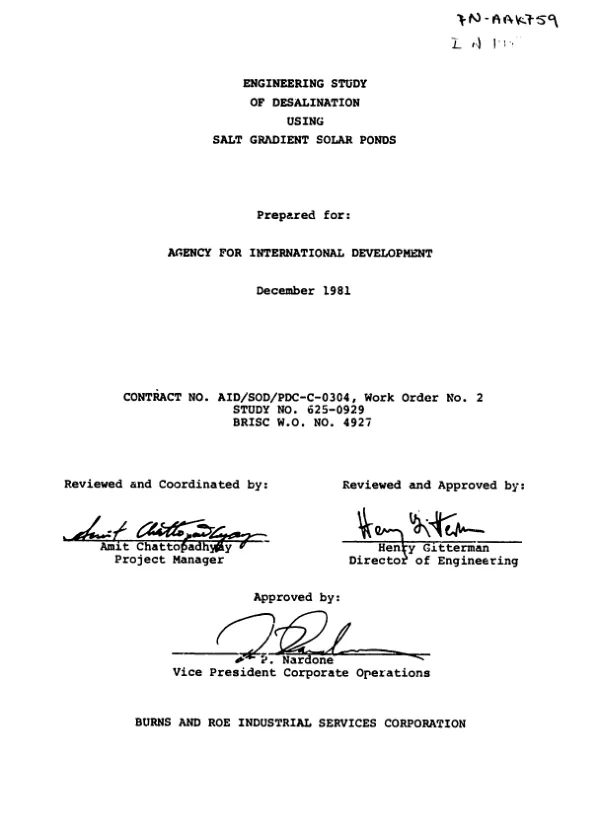
Engineering study of desalination using salt gradient solar ponds
Potable water in the Cape Verde archipelago is scarce.
Chattopadhyay, Amit · 1981
Sign in to readA free account is required to download.
Abstract
Natural sources must be supplemented by desalinated water, production of which requires expensive petroleum. Thus, this report examines the technical and economic feasibility of using salt solar gradient ponds for desalination of seawater to serve the home and business needs of a community of 6,000 people such as Palmeiras, Island of Sal. All salt gradient ponds work on the same principle - by absorbing and maintaining heat in the form of insolation in the lowest, densest, and saltiest portion of the pond. This heat, which can then provide all or part of the energy required for the desalination process, is removed by running the concentrated salt brine through a heat exchanger which, in turn, transfers the heat to a power plant. Two types of plants were considered: a multistage flash distillation (MSF) plant which uses the hot pond brine (either once through or recycled) for seawater heating and a reverse osmosis (RO) plant which uses low temperature rankine-cycle power. Although the MFS process is proven, yields higher quality distilled water, and may be more reliable, RO plants have faster start-up and shut-down, produce water which is less corrosive, and are simpler to operate. Capital costs are 13% less for the MSF plant (due to the reduced size and cost of the pond), while annual operating costs are 18.4% less for the RO plant. Based on the the smaller size of the plant and on its reduced power requirements, the authors select the RO plant as best-suited to conditions on the Island of Sal. Although the solar pond does yield a positive internal rate of return, this return is inferior to that of either a diesel-powered or wind-powered system. It is therefore recommended that construction of a salt gradient pond be postponed until economic conditions are more favorable. The text includes numerous tables, diagrams, and calculations; a 25-item list of references (1966-81) is attached.
Related documents