USAID DEC
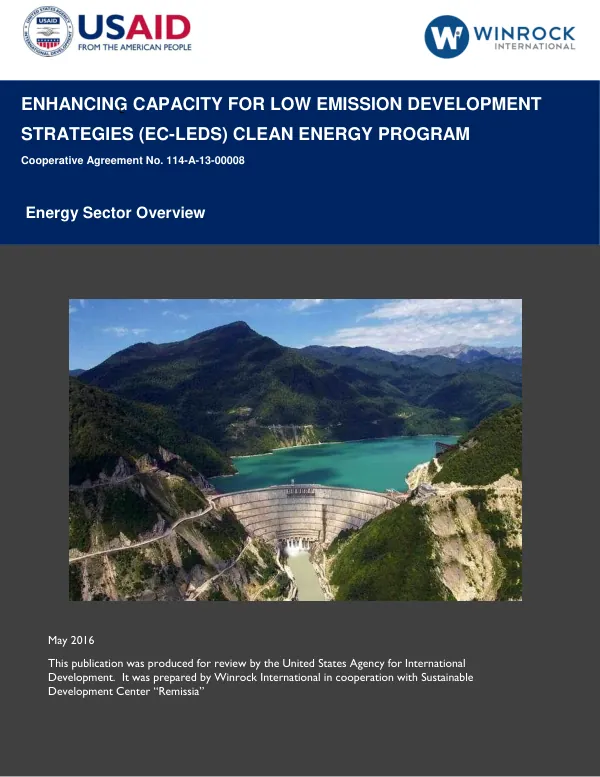
Enhancing Capacity for Low Emission Development Strategies (EC-LEDS) Clean Energy Program: Energy Sector Overview
Sign inGEORGIA NATIONAL ELECTRICITY AND WATER SUPPLY REGULATORY COMMISSION
Enhancing Capacity for Low Emission Development Strategies (EC-LEDS) Clean Energy Program: Energy Sector Overview
The energy sector of Georgia consists of traditional sub-sectors of electricity generation and fuel industry, including thermal and hydropower plants, electricity and fuel networks, transport and distribution gas pipelines, transit oil pipelines, oil and natural gas extraction plants, coal mines, and renewable energy resources such as geothermal waters, bio, wind, and solar resources.
2016 · 21 pages
Sign in to readA free account is required to download.
Abstract
The Georgian national energy sector is represented by the Ministry of Energy, which is responsible for energy policy elaboration and implementation, independent regulatory agencies, companies responsible for electricity and heat production, transmission, and distribution, and different categories of consumers. The Ministry of Energy elaborates and implements the energy policy, defines the rules for business relations and collaboration between different parties, facilitates the escalation of investment flows into the sector, plans its rehabilitation and development, participates in the development of legal and regulatory frameworks, supports elaboration of transit and import/export relations and infrastructure, and the state programs supporting energy efficiency and environment protection. The Georgian National Energy and Water Supply Regulatory Commission (GNEWRC) independently regulates the relations between consumers and energy companies mainly based on the Georgian Law on “Electricity and Natural Gas” and the legal acts of the Commission itself. GNEWRC issues and regulates the licenses in electricity and natural gas sectors (except for exploration and extraction activities), monitors and supervises the activities of licensees, defines and regulates electricity tariffs for generation, transmission, dispatch, import, export, and consumption. The natural gas sector of Georgia is divided into regulated and deregulated segments, with tariffs for the supply of natural gas to a regulated part of residential consumers and thermal energy plants determined by GNEWRC. The Commission also regulates network activities within the sector and issues licenses for network (transportation and distribution) companies. The wholesale market of electricity generation in Georgia is represented by generators, importers, and exporters of electricity, licensees of distribution (on supply side), direct customers, and service providers – transmission system operator, market operator, and licensee of network transmissions services. The main actors of the retail market are distribution licensees (on network services and supply side), small capacity power electricity plants, end-user consumers, and service providers. Any entity registered as a qualified enterprise has the right to import and/or export electricity, with the price of export open and not pre-defined, while in case of import, GNEWRC defines the formula for price calculation. By 2016, the energy generation of Georgia consisted of 4 thermal power plants and up to 50 hydro power plants, with a total installed capacity of 3,750 MW. The electricity generated by electricity power plants can be bought by a market operator, distribution companies, and direct consumers based on supply agreement. The market operator trades balancing electricity and guaranteed capacity based on tariffs defined by GNEWRC, ensuring the stability of the network and balancing the market. The electricity transmission grid of the country works on 500, 3030, 2020, 110, and 35 kilovolt (kV) voltage, with a total length of electricity transmission lines of 3,264.95 km and a total installed capacity of 92 substations of 10,212.6 Mega-volt-ampere (MVA).
Related documents
Documents in this collection
 2015
2015USAID DEC
Georgia Energy Regulatory Partnership: Technical Assistance on Electricity Distribution System Operations and Development of Grid Code
Open record 2016
2016USAID DEC
Georgia Energy Regulatory Partnership: Technical Assistance on Customer Switching Rules and Supplier of Last Resort Rules
Open record