USAID DEC
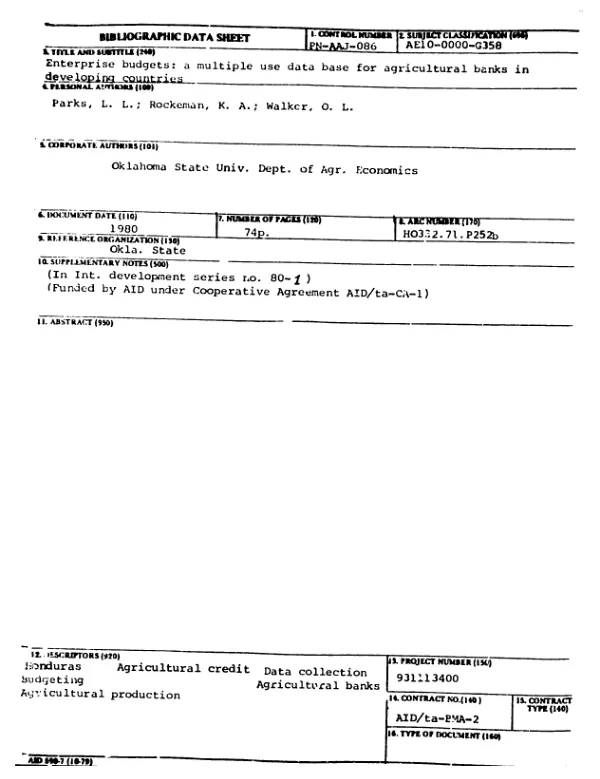
Enterprise budgets : a multiple use data base for agricultural banks in developing countries
Sign inOKLAHOMA STATE UNIVERSITY. DEPT. OF AGRICULTURAL ECONOMICS
Enterprise budgets : a multiple use data base for agricultural banks in developing countries
Enterprise budgets -- statements of the particular physical and financial inputs needed to obtain a specified amount of output -- play an important role in institutions that finance agricultural production by providing an ex ante estimate of production costs and returns.
Parks, Loren L.; Rockeman, K. A. +1 more · 1970
Sign in to readA free account is required to download.
Abstract
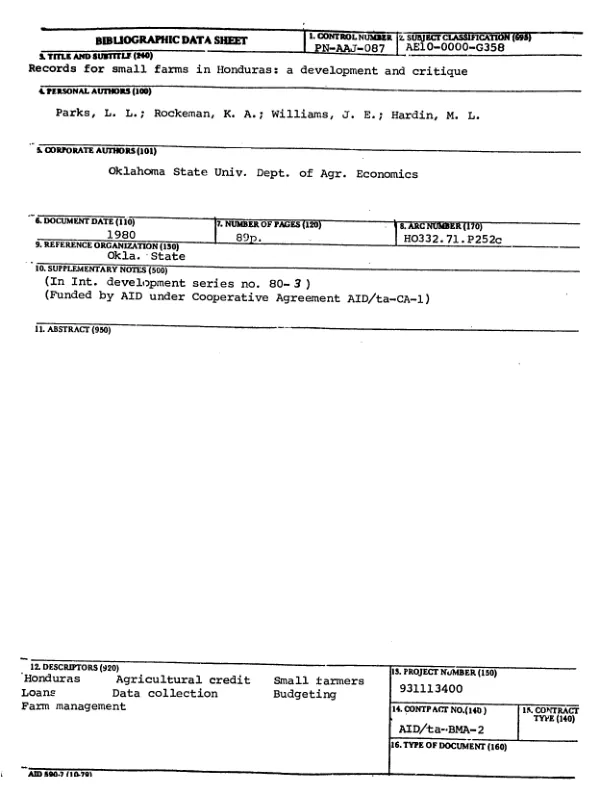
This report focuses on developing and using standard enterprise budgets to aid agricultural development banks, specifically, the National Agricultural Development Bank of Honduras, to evaluate loans. The Bank"s previous budget system had several faults. Budgets were not uniformly prepared, excluded fixed costs and some other variables, ignored regional differences, and were not prepared for livestock loans. The new budget system provides basic data required for economic analyses (e.g., farmer"s loan repayment capacity, cash flow, capital needs). It is designed to be simple for Bank personnel to use, accurate yet low cost, rapid, and flexible. To assist budget preparation, Honduras was divided into 13 regions according to ecological homogeneity and Bank branches. A loan officer and staff from each area were trained. Region-specific budgets with sections on labor, contracted services, materials, other costs, total cost, detailed other costs, and profitability were prepared for all Bank-financed crops. Livestock production budgets were similarly designed but were more difficult to implement because livestock analysis was a new concept for Bank employees. Problems occurred regarding definition of terms; verification; determination of yields, wages, and livestock value; inclusion of noncommercial enterprises; rounding-off numbers; and using farm records to verify budget coefficients. The report concludes that the following contributed to the new system"s success: (1) providing intensive training to branch office loan officers; (2) experimenting with different methodologies in one area to gain experience and limit errors in other regions; (3) establishing a rapport between Bank and field personnel; and (4) working from the bottom up to design a theoretically sound as well as a practicable system. Three references (1980) in English and Spanish, a training program, sample computer coding sheets, and crop budgets are appended.