USAID DEC
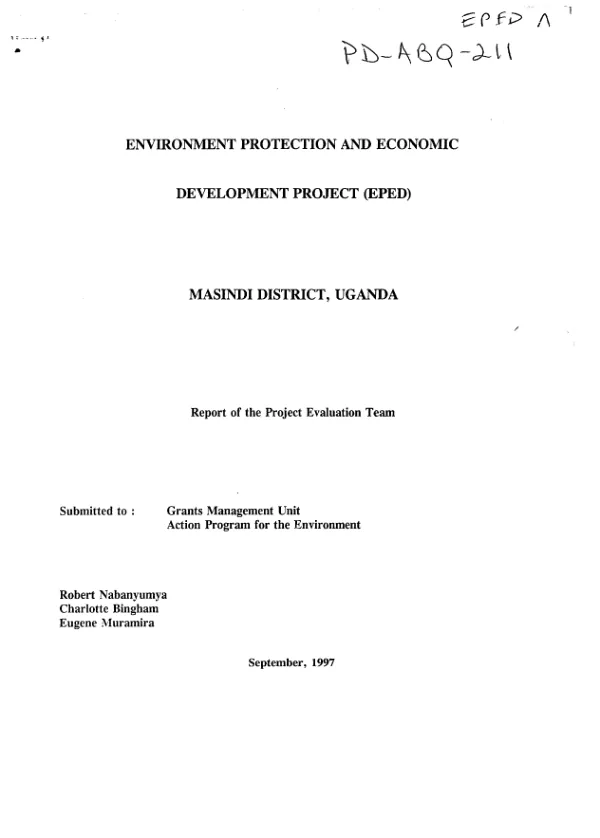
Environment protection and economic development project (EPED), Masindi District, Uganda : report of the project evaluation team
Sign inUSAID. MISSION TO UGANDA
Environment protection and economic development project (EPED), Masindi District, Uganda : report of the project evaluation team
Evaluates the Environment Protection and Economic Development (EPED) Project, designed to lay the groundwork for long-term protection of Murchison Falls National Park (MFNP) and the Bugungu and Karuma Wildlife Reserves in Uganda.
Nabanyumya, Robert|Bingham, Charlotte|Muramira, Eugene · 1997
Sign in to readA free account is required to download.
Abstract
Interim evaluation covers the period 7/96-8/97. The project is part of the Action Program for the Environment (APE) program. The project has been very successful in strengthening the capacity of Masindi District for effective planning and in the relocation of encroacher communities from the Karuma Wildlife Reserve. Concerning district environmental and natural resources management planning, achievements at the village level were in excess of expectations, because the project director was able to leverage funds from the district and from another project. Subcounty plans were not achieved due to lack of technical capacity at that level. A Masindi District sustainable development plan has been drafted. The district's resource planning efforts are serving as a model for the decentralization of environmental planning, impact assessment, and data collection for the National Environment Management Authority (NEMA). EPED has fully met the targets for the 20-month level of the monitoring and evaluation (M&E) framework and has set the stage for effective integration of the host community and the relocated population. Measures for monitoring biodiversity in the reclaimed area have been put in place and baseline data have been collected. The relocation of 125 families has successfully vacated an estimated 500 hectares of land in the Karuma Wildlife Reserve; this is a necessary, but not sufficient, element to ensure protected area integrity. EPED has no provisions for ensuring monitoring and management of the vacated area by the Uganda Wildlife Authority (UWA), and currently has no resources to handle the remaining, existing encroachers (approximately 400 families) in the Karuma Reserve, not to mention Bugungu. The limited success in enabling buffer zone communities to sustain economic development can be attributed to the limited participation and effectiveness of the designated partner, the Masindi Seed and Grain Growers Association (MSGGA), though this problem is likely to be overcome now that new partners have been identified. In terms of sustainability, prospects are relatively good for making effective use of the planning structures and systems now being set up for district-, subcounty-, and village- level planning. However, sustainability of these systems is not likely to be achieved in the 18 months remaining in the project. Even if EPED resources for this component had been considerably more generous, the capacity of the district and other partners to absorb these resources in a such a short time would have been in doubt. It is too early to tell whether economic initiatives and empowerment will be sustainable. Securing the integrity of the protected areas will take longer than the project life, and further input, and possibly a second phase of the project, is still required. A lesson learned is that, despite limited resources, and in contrast to past experience in Uganda, it is possible to relocate people out of protected areas in a humane manner. Relocation under EPED offers a model for similar situations where available, unclaimed lands exist in the vicinity, and can be modified for areas where land would have to be purchased. Although the EPED budget did not provide for the considerable attention that needs to be paid to the timing, logistics, emergency support, and other forms of social, economic, and psychological assistance, the project director was sure that these needs were met to the extent feasible. Thus, this relocation experience repeats lessons learned elsewhere. (Author abstract, modified)
Related documents