CH2M HILL INTERNATIONAL SERVICES, INC.
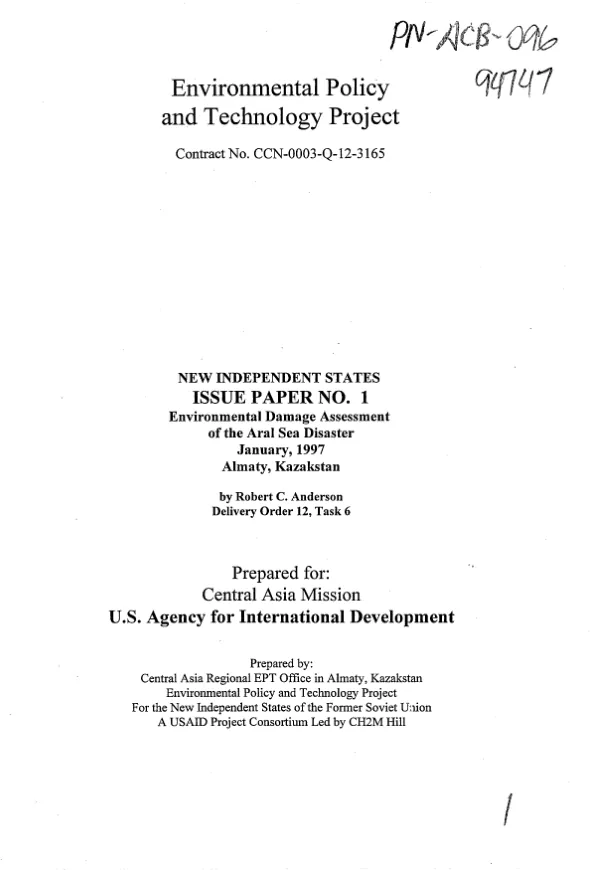
Environmental damage assessment of the Aral Sea disaster
In the 1960s, Soviet planners diverted most of the water flowing in the Amu Darya and Syr Darya rivers to irrigate nearly 3 million hectares (ha) of formerly arid lands.
Anderson, Robert C. · 1997
Sign in to readA free account is required to download.
Abstract
Some 50 billion cubic meters (50 km3) of water no longer flowed to the Aral Sea each year, with the consequence that the Aral Sea began to steadily diminish. From a volume of over 1,000 km3 in 1960, the sea now occupies a volume of well under 300 km3. The environmental consequences of water diversions are very serious. Human health, agricultural activity, living conditions, recreation and tourism, the once-abundant fisheries, flora and fauna, and the local climate have all been affected adversely. This study develops a preliminary estimate of the economic value of the damages: some $1.25 to $2.5 billion annually. Future work can and probably should be conducted to refine this estimate, for the magnitude of some of the categories of damage is highly uncertain. The damage estimate indicates what water is worth to the Aral Sea as the sixth consumer of water in the region (in addition to the five republics in the basin). Each cubic meter of water is worth, on average, the damage figure ($1.25 to $2.5 billion) divided by the quantity lost (50 billion m3), or 2.5 to 5.0 cents per m3. At present, many users of water in the basin do not pay for water, and those that do typically pay very little. As a result, water is wasted on a huge scale. Large-scale users actually should be paying base-level user charges equal to the value of water to the Aral Sea, plus the additional costs of building and operating delivery systems. If such water charges are implemented in the region, the revenues would be substantial and could be used to help restore the environment and for other governmental purposes. While many users would complain that they could not afford to pay such charges, it is largely a problem of current excessive levels of consumption and price controls imposed on the output of agricultural enterprises. The principles of damage assessment described in this paper can be applied to other regional issues, such as the level of charges to be used when an upstream republic sends polluted water to a downstream republic, or when a point source discharges polluted waste water to surface waters. (Author abstract)
Related documents
![Environmental impact assessment [for] Delta Solb Preparatory School](https://covers.devme.ai/gen/64701.webp)