USAID DEC
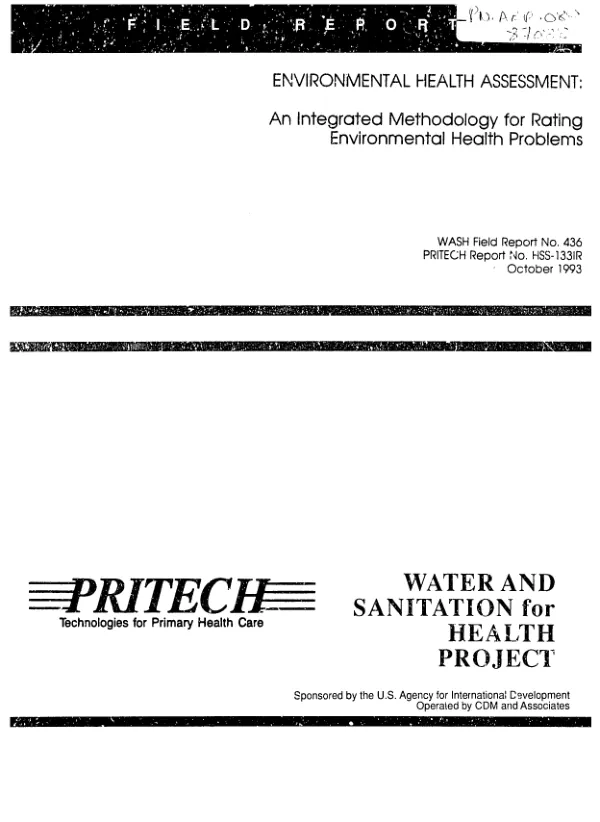
Environmental health assessment : an integrated methodology for rating environmental health problems
Sign inCAMP DRESSER AND MCKEE, INC. (CDM)
Environmental health assessment : an integrated methodology for rating environmental health problems
This report describes the components of an environmental health assessment (EHA).
Brantly, Eugene; Hetes, Robert · 1993
Sign in to readA free account is required to download.
Abstract
An EHA examines a broad range of environmental conditions that have adverse health consequences and determines which present the greatest risk to public health. The EHA methodology integrates three approaches to investigating environmental health problems: health risk assessment; health effects (outcome) assessment; and ethnographic investigation of health-related behavior. It is a multidisciplinary approach, using specialists in epidemiology, anthropology, and health-related behavior, in addition to specialists in exposure assessment and risk assessment. An EHA examines the potential health consequences of environmental conditions in eight categories: potable water supply; sanitation and wastewater; solid waste; food hygiene; occupational health; air pollution (indoor and ambient); toxic and hazardous materials; and traffic and household injuries. The report includes an approach to rating the relative significance of environmental health problems, and describes the types and sources of data needed to conduct an EHA. The report also suggests a typical schedule for conducting an EHA, describes the limitation of the methodology, and identifies the most important aspects of the methodology that require further development. The EHA methodology described in this document was field-tested in Ecuador in June 1992. (Author abstract)
Related documents