USAID DEC
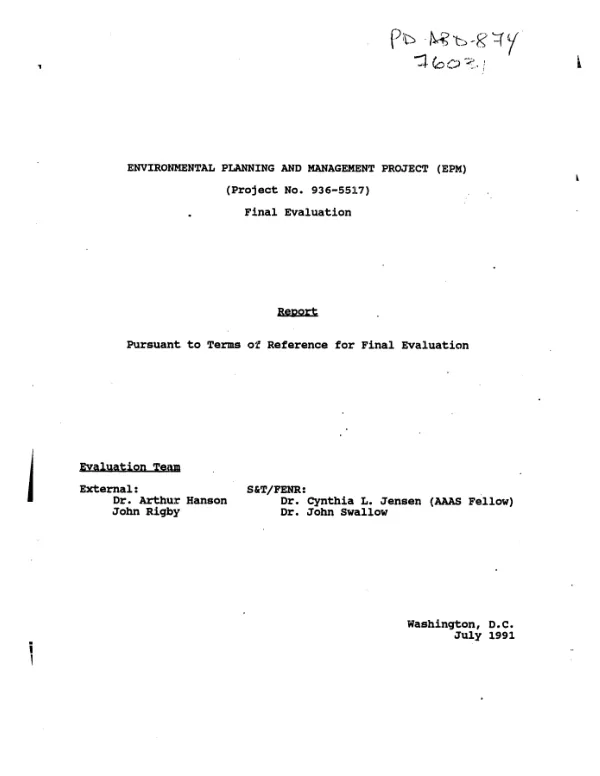
Environmental planning and management project (EPM) (project no. 936-5517) : final evaluation
Sign inUSAID. BUR. FOR SCIENCE AND TECHNOLOGY. OFC. OF FORESTRY, ENVIRONMENT AND NATURAL RESOURCES
Environmental planning and management project (EPM) (project no. 936-5517) : final evaluation
Final external evaluation of a project (1982-1992) to strengthen the capacity of public and private institutions in developing countries to manage and conserve natural resources.
Hanson, Arthur; Jensen, Cynthia L. · 1991
Sign in to readA free account is required to download.
Abstract
The World Resources Institute"s (WRI) Center for International Development and Environment (CIDE) implemented the project. After the 1985 project revision, project activities were carried out in 53 countries -- 24 in Africa, 14 in Asia/Near East, and 15 in Latin America -- under four interrelated programs: (1) natural resource management strategies and assessments (NRMSA); (2) support to NGO"s; (3) natural resource data management (NRDM); and (4) sustainable agriculture (SA). Nearly half of the project"s activities were NRMSA related; these included environmental profiles, natural resource assessments, and environmental strategies and action plans. The project"s participatory approach helped strengthen host country capacities from the governmental to the grassroots level, contributing to policy formulation, the creation and strengthening of institutions, multi-sectoral coordination, capacity for data management and environmental assessment, and mechanisms for private sector/NGO participation in NRM. Most NRMSA activities have been associated with extensive follow-on activities by host country institutions and external support agencies. NGO support activities have included the development and dissemination of guides and analytical tools on participatory approaches to NRM. With financial and technical assistance, the project has actively brought NGO"s into national level NRM policy and planning activities. Through an NGO policy impact program (partially funded by the project and with major support from U.S. foundations), CIDE has undertaken a research and case study program to document community experiences in NRM. NRDM activities have increased the availability, analysis, and use of natural resources data to and by international agencies. While this component had less impact on the institutional level, the value of NRDM for strengthening national capabilities is being increasingly recognized, and tighter links between NRDM and NRMSA are planned. The sustainable agriculture program was a temporary casualty of the 1988 merger (which resulted in the creation of CIDE) between WRI and the original grantee, the International Institute for Environment and Development, which had given SA a prominent place in the project. However, in 1990 CIDE began to reestablish itself in the field of SA, and is currently examining how best to do so. CIDE"s renewed interest in SA addresses factors common to other project areas, e.g., increasing grassroots participation and promoting equity, and could also bring into focus elements not currently addressed under the project. The project has also partially supported a number of activities outside the four main theme areas, including the preparation of 30 biodiversity profiles and 15 tropical forestry and land use plans. Efforts to examine gender-related constraints in NRM were slight and unsystematic. The activity of implementing the project has strengthened CIDE"s institutional and technical capabilities; the benefits could have been greater, however, had the study of CIDE"s institutional strengthening needs called for in the 1989 Project Paper supplement been conducted. The evaluation recommends a follow-on project, focusing on developing host country institutional capacity for NRM, and characterized by host country institutional ownership of the NRM processes and public participation at the grassroots level. The current NRMSA framework could, with some broadening, be made the overall framework for the follow-on project.
Related documents