USAID DEC
Epidemic preparedness and response in Africa : an epidemiological block approach -- summary report
Sign inACADEMY FOR EDUCATIONAL DEVELOPMENT, INC. (AED)
Epidemic preparedness and response in Africa : an epidemiological block approach -- summary report
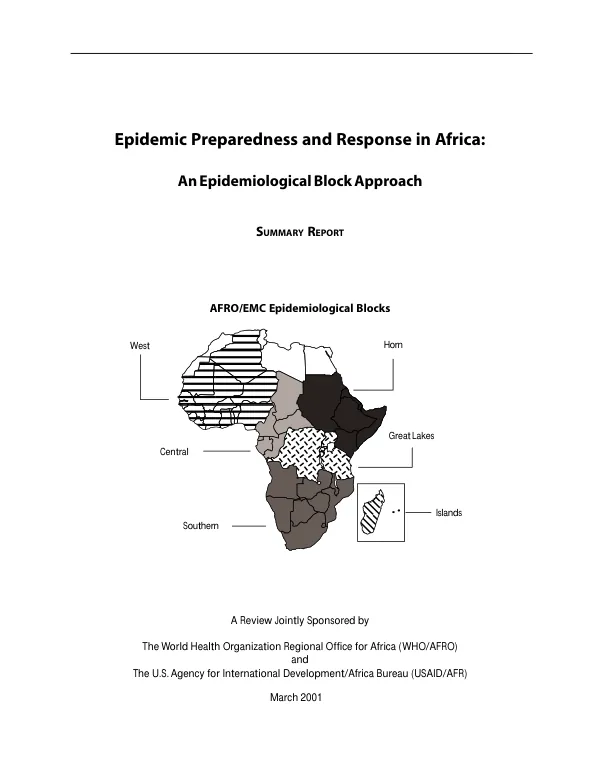
This report presents the epidemiological block approach used by the World Health Organization Regional Office for Africa (WHO/AFRO) to implement its Emerging and other Communicable Diseases Surveillance and Control (EMC) programs, and discusses the performance of the epidemiological teams in the West Africa Block (WAB) and Great Lakes Block (GLB).
2001
Sign in to readA free account is required to download.
Abstract
It discusses the availability and use of data for assessing trends in the incidence, mortality, and occurrence of outbreaks of epidemic-prone diseases, cholera and meningitis in particular. In their few years of operations, the EMC teams in WAB and the GLB have provided valuable technical assistance to many countries in emergency preparedness and response (EPR). The program is starting to show some results, including: timely detection and notification of outbreaks; publication on a regular basis of epidemiological bulletins at the subregional levels; increased availability of vaccines, drugs, and other supplies for quick response to initial cases; and strengthened laboratory capacity for the confirmation of epidemics. In the WAB, the EMC team trained biologists of national reference laboratories from eight countries. A number of laboratory technicians have subsequently been trained in 10 WAB countries. In Uganda, an integrated disease surveillance (IDS) assessment was performed in March 2000, followed by the development of a 5-year plan of action. The broad involvement of the Ministry of Health and the support of the GLB EMC team, the Institute of Public Health, the Centers for Disease Control, and WHO made this a landmark event in public health in Uganda. An IDS committee is now in place and 10 districts have already been trained on the improved surveillance system. At least partially as a result of the EMC program, there is an increasing awareness of the feasibility of better control of epidemic-prone diseases and an increasing demand from member states for technical and financial support for EPR activities. Given the limited resources currently available for the EMC program and the high expectations from member states, WHO/AFRO needs to increase its advocacy, collaboration, and resource mobilization efforts. Recommendations to achieve these objectives are detailed briefly in conclusion. (Author abstract, modified)
Related documents
Documents in this collection
![Epidemic preparedness and response in the Africa region : a review of the program in the WHO/AFRO/EMC [World Health Organization/Regional Office for Africa/Emerging and Other Communicable Diseases] West Africa and Great Lakes epidemiological blocks](https://covers.devme.ai/gen/106782.webp) 2000
2000USAID DEC
Epidemic preparedness and response in the Africa region : a review of the program in the WHO/AFRO/EMC [World Health Organization/Regional Office for Africa/Emerging and Other Communicable Diseases] West Africa and Great Lakes epidemiological blocks
Open record 1996
1996USAID DEC