USAID
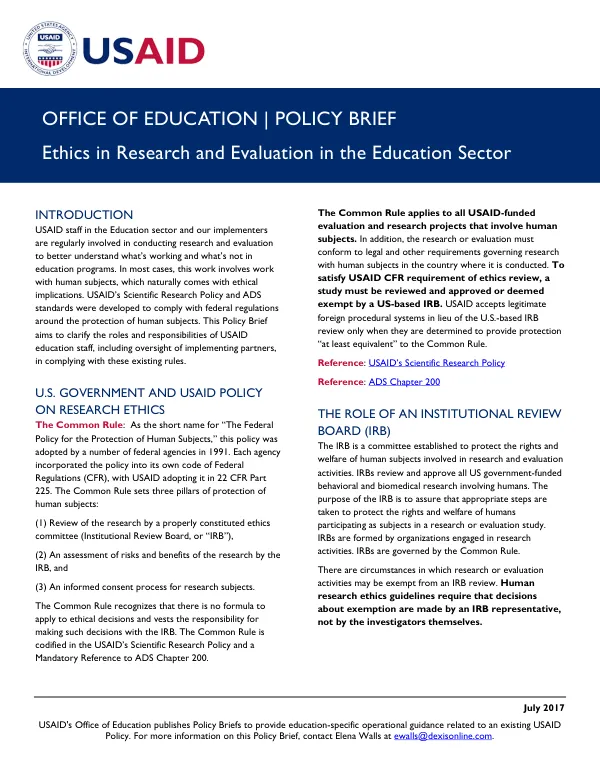
Ethics in Research and Evaluation in the Education Sector
The USAID Office of Education published a Policy Brief in July 2017 to provide education-specific operational guidance related to the USAID Scientific Research Policy.
2017 · 5 pages
Sign in to readA free account is required to download.
Abstract
The Policy Brief aims to clarify the roles and responsibilities of USAID education staff, including oversight of implementing partners, in complying with existing rules for the protection of human subjects. The Common Rule, adopted by the USAID in 22 CFR Part 225, sets three pillars of protection for human subjects: review of the research by a properly constituted ethics committee (Institutional Review Board, or IRB), assessment of risks and benefits by the IRB, and informed consent process for research subjects. The Common Rule applies to all USAID-funded evaluation and research projects that involve human subjects, and research or evaluation must conform to legal and other requirements governing research with human subjects in the country where it is conducted. The IRB is a committee established to protect the rights and welfare of human subjects involved in research and evaluation activities. IRBs review and approve all US government-funded behavioral and biomedical research involving humans. The purpose of the IRB is to assure that appropriate steps are taken to protect the rights and welfare of humans participating as subjects in a research or evaluation study. USAID staff, including the Contracting Officer's Representative (COR) or Agreement Officer's Representative (AOR), are responsible for ensuring that all research and evaluation activities funded by USAID comply with USAID's policy on the protection of human subjects as well as all relevant local laws and regulations. The award holder is responsible for managing the approval process and adhering to study plans approved by the IRB and/or local ethics review committee. The Policy Brief provides additional information on the definition of research activities, IRB approval process and timelines, types of studies exempt from IRB review, and illustrative award language on protection of human subjects. The Common Rule defines research as a systematic investigation, including research development, testing, and evaluation, designed to develop or contribute to generalizable knowledge. It defines a human subject as a living individual about whom an investigator conducting research obtains data through intervention or interaction with the individual. USAID's Cognizant Human Subjects Officer (CHSO) assists with guidance and interpretation of the Common Rule as it applies to USAID-funded work. The Policy Brief also provides guidance on how to obtain IRB approval, including the documentation required by IRBs, such as study plans, final or near-final data collection instruments, consent forms, and procedures for protecting confidentiality of respondents. Research and evaluation activities that are exempt from a full IRB review include those that involve no more than minimal risk to subjects, such as surveys, interviews, and focus groups. However, decisions about exemption are made by an IRB representative, not by the investigators themselves or by USAID staff. The Policy Brief provides additional information on the types of research and evaluation activities that are exempt from a full IRB review.