USAID DEC
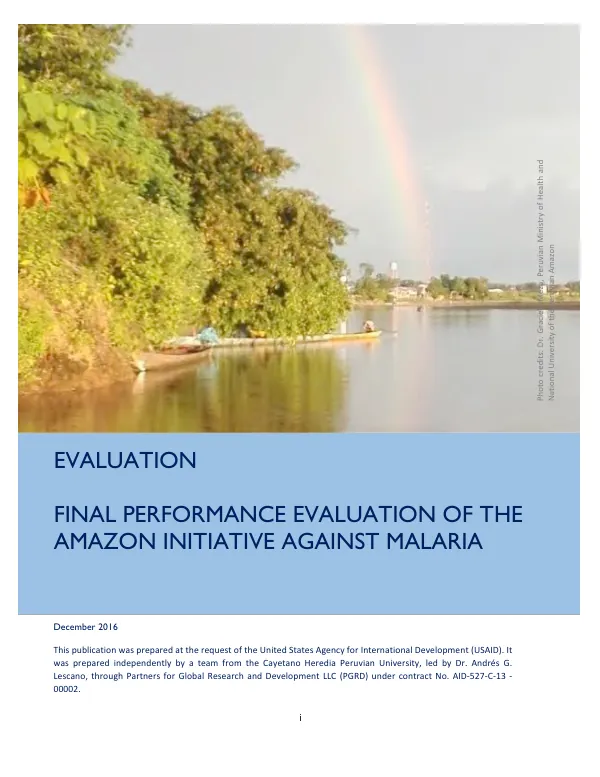
Evaluacion final de desempeno de la iniciativa Amazonica contra la malaria : respondiendo a escenarios cambiantes de transmision de la malaria
Sign inPARTNERS FOR GLOBAL RESEARCH AND DEVELOPMENT, LLC (PGRD)
Evaluacion final de desempeno de la iniciativa Amazonica contra la malaria : respondiendo a escenarios cambiantes de transmision de la malaria
The objectives of this final evaluation were to: (1) identify the contribution of the USAID supported Amazon Malaria Initiative (AMI) to the ability of eleven partner countries" National Malaria Control Programs to control malaria from 2001-2015; (2) evaluate the capabilities of partner countries to address the changing scenarios of malaria transmission; and, (3) identify the main challenges that countries may face while confronting new scenarios of malaria transmission as well as the challenges that should be addressed by international cooperation agencies.
Lescano, Andres G.; Rosas, Angel +4 more
Sign in to readA free account is required to download.
Abstract
The evaluation used a mixed analytical approach incorporating qualitative and quantitative methods. The qualitative component included in-depth interviews with key informants, content analysis of selected documents, and case studies from four partner countries. The quantitative component included the analysis of data obtained from epidemiological databases on malaria and the review of selected documents. AMI partner countries have shown a substantial but heterogeneous reduction of malaria cases since the year 2001, including some setbacks and slower progress in later years, especially the last four. Partner countries have achieved substantial progress and developed important capabilities in all six of the AMI Program technical focus areas. AMI supported capacity development that addressed country-specific malaria control needs and scenarios. The program served as a platform for inter-country collaboration, introducing innovations and strengthening information systems through national communication strategies and alliances. Key capacities for malaria control have been built and enhanced, and these continue to respond to changing epidemiological scenarios. However, there is a need to make improvements, such as better planning and monitoring of activities including alignment to PAHO´s strategy, in order to consolidate progress and prevent the reintroduction of malaria. The principal recommendation of this evaluation is to maintain the progress to date. Malaria elimination is still in the distant future, and it is more important to continue building strong programs, overcome current and upcoming crises and prevent re-emergence in settings where malaria is under control. The control of malaria is not exclusive to the national level, but instead requires a regional agenda meriting support from the international cooperation, as PAHO, in coordination with partner countries. (Author abstract)
Related documents