USAID DEC
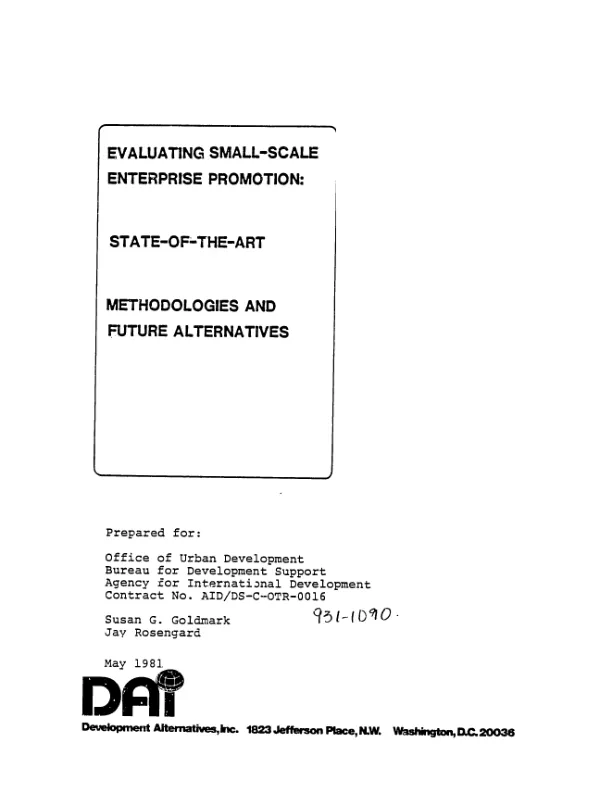
Evaluating small scale enterprise promotion : state-of-the-art methodologies and future alternatives
Sign inDEVELOPMENT ALTERNATIVES, INC. (DAI)
Evaluating small scale enterprise promotion : state-of-the-art methodologies and future alternatives
As part of a project to develop a handbook to evaluate the impact of small-scale enterprise (SSE) projects, this state-of-the-art paper reviews methodologies currently used in evaluating SSE projects.
Goldmark, Susan G.; Rosengard, Jay · 1981
Sign in to readA free account is required to download.
Abstract
After defining common terms of reference for SSE practitioners, the author reviews the key determinants of SSE evaluation methodologies (level and users of and data bases for evaluation; budgetary and timing parameters) and points out the need to examine the trade-offs between these determinants critically. An analytical framework for assessing the impact of SSE"s, focusing on the development hypotheses underlying SSE projects and the hierarchy of impacts (on enterprises, on the community, and on benefit and cost distribution), is delineated, as are linkages within the hierarchy. Alternative SSE evaluation methodologies are examined in terms of their functional components (indicators of an SSE project"s direct impact on an enterprise"s profitability and sustainability and on community income and employment; data collection techniques; and methods of data analysis). Stress is given to: the importance of indicators of why the project was helpful or not; its qualitative effect on the enterprise; and enterprise-community interaction. Suggestions are made to improve formal and informal data collection techniques. The following deficiencies in past SSE evaluations are identified: the evaluation"s level, user, budget, timing, and data base heavily determine the methodology chosen; the diverse nature of SSE projects and the lack of standardized impact indicators impede legitimate comparison of SSE projects; attributing impact to SSE projects is the most difficult methodological issue in assessing SSE project impact; the cost-effectiveness of tracking impact indicators over the life of an SSE project has not been documented; direct and indirect income and employment generated by SSE projects are the two most difficult and costly effects to quantify; and the trade-offs between cost, accuracy, and utility of alternative SSE impact indicators and data collection techniques have not yet been explored. A detailed plan of action for follow-on field work in four countries is presented. Appendices detail the U.S. institutions and the literature reviewed (101 items, 1964-80) for the study, and include abstracts of 10 SSE impact evaluations.

![Toward more cost-effective nonfinancial assistance : case studies in subsector-based MSE [micro and small enterprises] development](https://covers.devme.ai/gen/31929.webp)