MICHIGAN STATE UNIVERSITY. DEPT. OF AGRICULTURAL ECONOMICS
Evaluating trends in children"s nutritional status in Rwanda
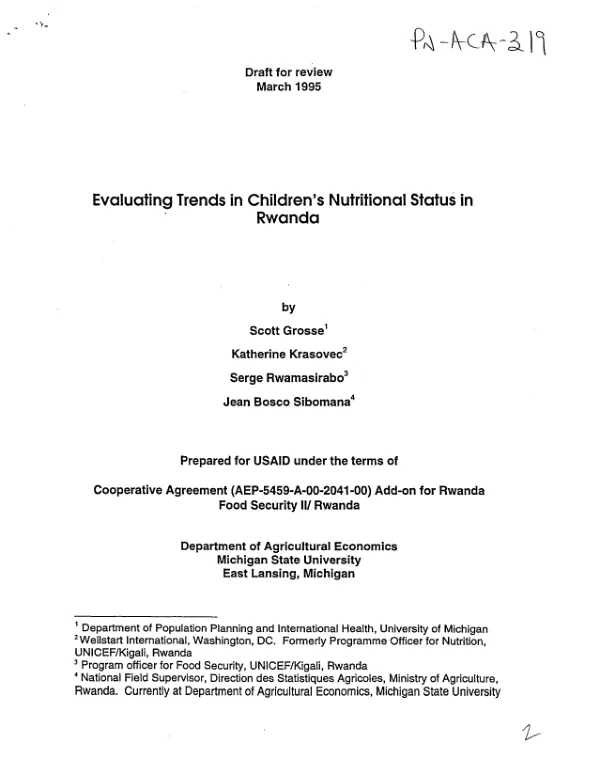
This paper utilizes anthropometric data from the USAID-supported National Nutrition and Food Security Survey (ENNSA) to analyze trends in the nutritional status of children under age 5 in Rwanda.
Grosse, Scott; Krasovec, Katherine +1 more · 1995
Sign in to readA free account is required to download.
Abstract
Analyses of these data lead to the conclusion that there was no worsening in the nutritional status of children in established rural and urban populations of Rwanda between the early 1980"s and the early 1990"s. Nor was there any evidence of short-term deterioration during the crisis years of late 1991 to early 1993. The nutritional situation of internally displaced populations in Rwanda during the early 1990"s was more grim, and varied with the availability of food aid. Slightly over 4% of Rwandans lived in displaced camps in 1993. Representative population-based surveys have covered only the non-displaced population and hence lead to a very slight downwards bias in the prevalence of malnutrition during the early 1990"s. Data on maternal anthropometry are also available from the ENNSA and provide another perspective on nutritional status of the farm population. While these data cannot be compared with other data from Rwanda to calculate trends, they are a useful benchmark for assessing the nutritional status of the Rwandan farm population as of 1991-92. The proportion of adult non-pregnant women with body mass index (BMI) below 18.5 kg/sq m is an indicator of chronic energy deficiency in a population. The proportions of non-pregnant Rwandan women with low BMI values in the various ENNSA rounds, 5-9%, are among the lowest reported for rural African populations. This is unambiguous evidence that chronic deficiency of food energy was not a widespread problem in Rwandan farm households during 1991-92. (Author abstract, modified)
Related documents
Documents in this collection
 2001
2001USAID DEC
Nutrition of young children and mothers in Rwanda : findings from the 2000 Rwanda demographic and health survey = Nutrition des jeunes enfants et des meres au Rwanda : resultats de l"EDS Rwanda 2000
Open record 2002
2002USAID DEC
![Nutrition of infants and young children in Zimbabwe : findings from the 1994 Zimbabwe DHS [demographic and health survey] survey](https://covers.devme.ai/gen/73753.webp)
![Situation nutritionnelles [i.e. nutritionelle] des jeunes enfants au Rwanda : une analyse de donnees anthropometriques collectees par l"enquete sur les conditions de vie des menages 1999-2001](https://covers.devme.ai/gen/23432.webp)