USAID DEC
Evaluation of accelerated impact program, improved rural technology, and women in development projects
Sign inDEVELOPMENT ASSOCIATES, INC.
Evaluation of accelerated impact program, improved rural technology, and women in development projects
Evaluates three projects - the Accelerated Impact Program (AIP), the Improved Rural Technology Program (IRT), and the African Women in Development Project (WID) - which fund quick-impact subprojects.
Roush, James L.|Knott, M. L. · 1982
Sign in to readA free account is required to download.
Abstract
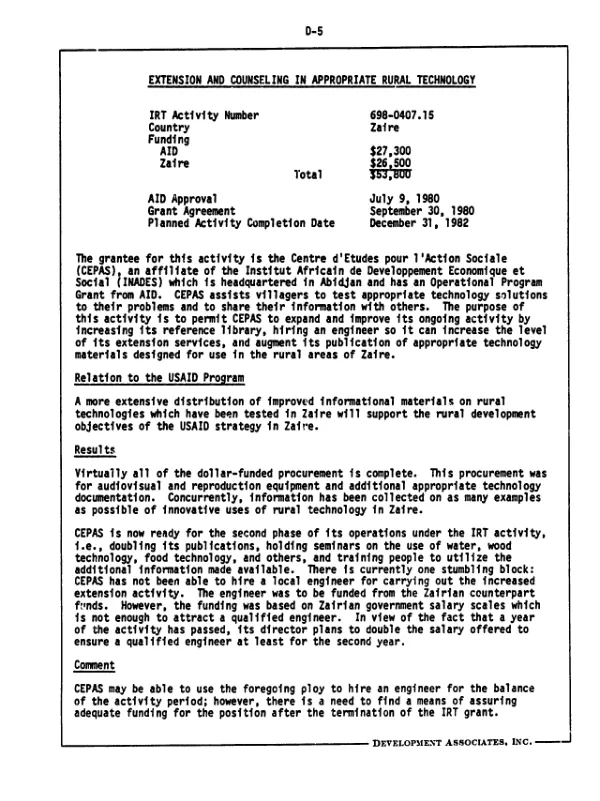
Special evaluation was conducted to assess the proposed FY83 unification of the three projects, covers the period 1976-82, and is based on visits to five African missions, a Peace Corps office, and seven subprojects in three countries. Nineteen missions in non-Sahelian countries have participated in one or more of the projects, and countries with large A.I.D. programs have participated more than expected. Activities to increase agricultural production have been the most prevalent, followed by those in renewable energy, public health, and rural water supply. Information on achievements is sparse because few subprojects are complete and there has been little reporting to AID/W. Of the the four completed IRT subprojects, one was abandoned while two others show promise. While enthusiastically received in host countries, all WID subprojects have had implementation difficulties; most are still salvageable but better information at AID/W is crucial to this task. Of the 14 AIP subprojects checked, 10 were having implementation problems. A problem common to all three projects was the initial approval process for individual activities; however, this process has recently been modified. IRT subprojects have been easier to implement because they are smaller in size and geographical scope, and because they are designed to further understanding of appropriate rural technologies in African governments in preparation for more sweeping projects. The authors conclude that there is still a need for the funding flexibility which these three projects afford, and recommend that the IRT be extended 3 years and that a single new project - Development Initiative and Responses (DIR) - replace WID and AIP. DIR should stress quick initiatives to respond to new policy and legislation, while IRT should be strengthened to truly promote greater acceptance of appropriate rural technologies and to provide guidance for more encompassing technology projects.