USAID DEC
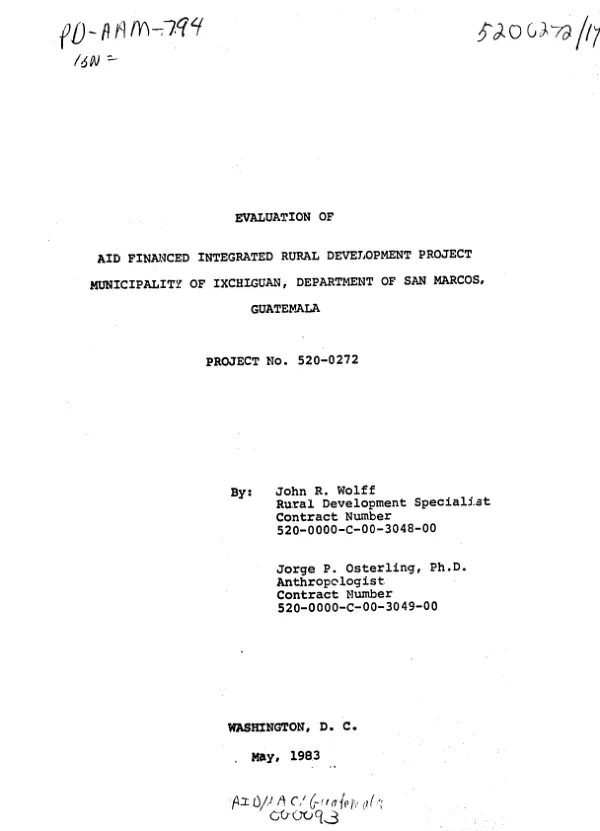
Evaluation of AID financed integrated rural development project municipality of Ixchiguan, department of San Marcos, Guatemala
Sign inUSAID. MISSION TO GUATEMALA
Evaluation of AID financed integrated rural development project municipality of Ixchiguan, department of San Marcos, Guatemala
Evaluates integrated rural development (IRD) pilot project in Ixchiguan, Guatemala.
Wolff, John R.|Osterling, Jorge P. · 1983
Sign in to readA free account is required to download.
Abstract
Special evaluation covers the period 10/79-4/83 and is based on document review, interviews with implementors and beneficiaries, and site visits. Major external changes - including the existence of a national rather than a regional strategy committee and especially the armed strife between the military and guerrillas which has led to evacuation of PCV's and the consequent abandonment of the youth club subproject (SP), transfer of the demonstration farm to the distant Town of San Marcos (where Project Hope lacks an office), and dispersion of the local improvement committees on which project strategy was based - have hindered the project, now in its final 5 months. Nonetheless, the project, which has been redesigned to comprise 49 SP's - 15 in health care and 34 in agriculture - in 38 villages in 9 municipalities (rather than 16 villages in one municipality), has been Guatemala's first successful experiment in IRD. The demonstration farm, complete with sanitary facilities, a vegetable garden, and a greenhouse for winter production, was completed the first year and has successfully planted a variety of crop and forage species. In the health SP, the project has trained 144 paraprofessionals and supported vaccination and de-parasitization compaigns. This training, along with increased farm yields and intensive zoonosis research, has improved the nutritional status of Ixchiguan residents. On the other hand, a lack of professionals has halted maternal/child health activities and curtailed dental services. In the preventive veterinary medicine SP, 96 vaccinators were trained and 80% of the animals in 10 communities were vaccinated or de-parasitized. Information on other livestock and other SP's is also provided. The project has shown the difficulties of erasing traditional practices and of trying to implement a large-scale project with a staff of five who lack adequate transportation and, more positively, the value of using a simple, small group strategy with the target population. The project, still largely at the experimental stage, should continue in a more limited way and in accordance with the several recommendations made in the evaluation.
Related documents
Documents in this collection
 1981
1981USAID DEC
Assessment of the second integrated rural development project; part I : the impact of the project upon farmers
Open record 1987
1987USAID DEC