USAID DEC
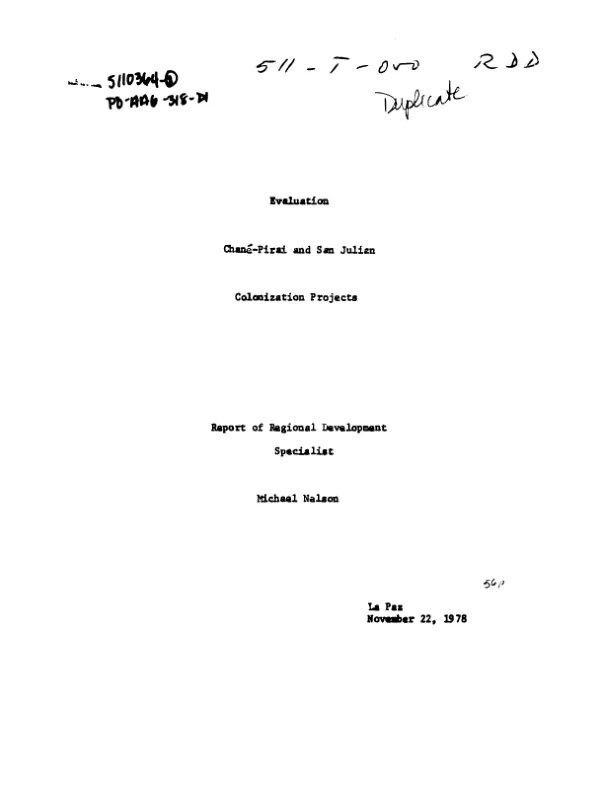
EVALUATION OF CHANE-PIRAI AND SAN JULIAN COLONIZATION PROJECTS -- REPORT OF REGIONAL DEVELOPMENT SPECIALIST
Sign inUSAID. MISSION TO BOLIVIA
EVALUATION OF CHANE-PIRAI AND SAN JULIAN COLONIZATION PROJECTS -- REPORT OF REGIONAL DEVELOPMENT SPECIALIST
Evaluates project to establish two colonies (San Julian and Chane-Pirai) on subtropical lands in southern Bolivia.
NELSON, MICHAEL · 1978
Sign in to readA free account is required to download.
Abstract
Evaluation covers the period 9/1/74-11/31/78 and is based on the report of a contracted regional development specialist. There were marked differences between the two colonies both in the funding provided and the development approach used. San Julian (SJ), a colony of 4,680 persons, was highly controlled, while the Chane-Pirai (CP) model provided support services only in an otherwise spontaneous settlement. SJ"s villages were geometrically laid out; roads, potable water, and machine clearing were provided prior to the colonists" arrival; an agricultural service center provided research, agricultural inputs, credit, and health services; and both orientation and community organization were emphasized through the use of experienced colonists and community promoters. The site preparation, the major innovation of the settlement, and the orientation processes have been very effective, leading to a more accelerated rate of development than would have been possible in a strictly spontaneous settlement area. Provision of basic human services, such as nutrition, education, and health, have made the community much more livable than spontaneous settlements, which tend to lack adequate services. Nonetheless, the high per capita cost of this settlement raises questions as to its replicability for large-scale, sustained settlement schemes. A cost-effectiveness index is difficult to calculate for the CP area due to the uncertain number of colonists (estimated at about 7,000). The less structured model is nonetheless highly effective, since the area has shown remarkable development and must be considered one of the most dynamic colonization zones in Bolivia. Further study of the SJ model"s applicability is needed before extension of the model to other areas is contemplated. Continued support to controlled experimentation with colonization consolidation is recommended. Part two of this evaluation examines the policy issues involved in the two colonization efforts (XD-AAG-318-1).