TROPICAL RESEARCH AND DEVELOPMENT, INC.
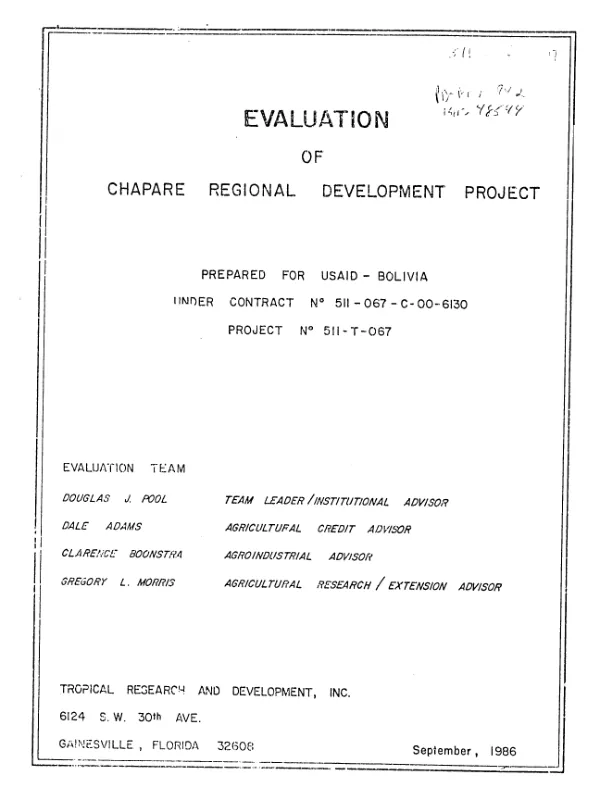
Evaluation of Chapare regional development project
Evaluates project to increase agricultural and forestry production in Bolivia's Chapare region.
Pool, Douglas|Adams, Dale W. · 1986
Sign in to readA free account is required to download.
Abstract
External evaluation covers the period 1983-9/86 and is based on site visits, document review, and interviews with involved personnel. Implementation has been impeded by several factors. The project design is overambitious, too inflexible for the difficult Chapare environment, and premised on the control of coca production - which was only achieved in 7/86, nearly 2 years after start-up. USAID/B's failure to assign sufficient management resources has, along with long delays in procurement, permitted or exacerbated administrative problems among the Bolivian implementing agencies. Also, Chapare lacks basic infrastructure and most project offices are perforce in Cochabamba, 180 km from the project area. Lack of coca control has made it impossible to implement some components, while progress in other areas has been slow because objectives were not clearly conceptualized and translated into an aggressive course of action. Stronger TA from the Experience, Incorporated team would have improved the development of technological packages. For example, cropping systems improvements have been neglected, even though Chapare farmers typically practice multiple cropping; more attention to annual-perennial intercropping is needed. Also, livestock activities should be eliminated; the region is not suited to cattle production, nor have farmers shown interest. The Chipiriri research station is located in an area ill-suited for agricultural production and atypical of most of Chapare; research on citrus and field crops should be transferred. Recruitment and training of promoters has proceeded well but deserves even greater attention since there is no assurance that research and extension will continue after project completion; publication of research results for promoters is essential. Marketing and related activities are far behind schedule. Virtually nothing has been done under the market services component, only 3 industries have been identified under the large agro-industry component and none would have significant impact on Chapare incomes (this component should be deleted), and no substantial progress has been made in small agro-industry development. Few farmers have access to the credit needed for the commercialization of crops requiring processing, such as coffee, and no formal credit delivery system exists. Project staff have been able to gain farmer confidence because the project has not been openly associated with coca eradication; this distinction should be vigorously maintained. Also, if coca control is not sustained, project funds should be reprogrammed into activities to reduce migration pressure into the region.