USAID DEC
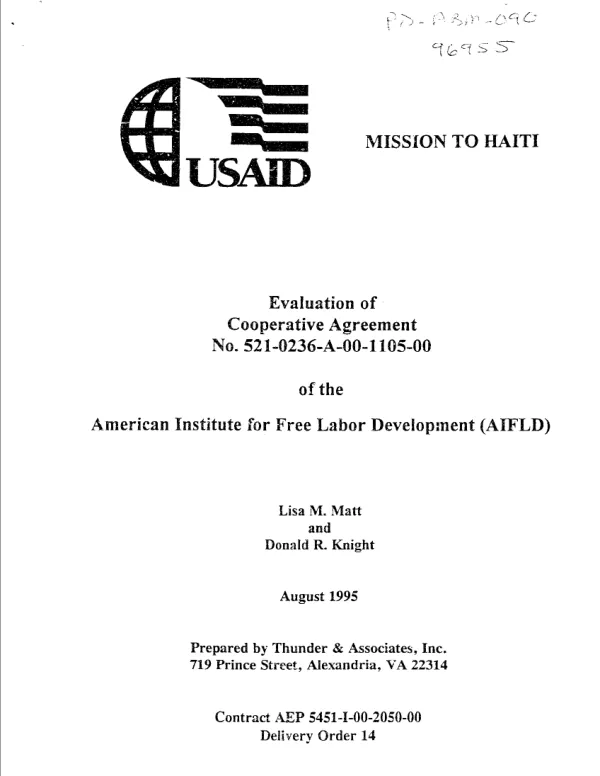
Evaluation of cooperative agreement no. 521-0236-A-00-1105-00 of the American Institute for Free Labor Development (AIFLD)
Sign inTHUNDER AND ASSOCIATES, INC.
Evaluation of cooperative agreement no. 521-0236-A-00-1105-00 of the American Institute for Free Labor Development (AIFLD)
Evaluates grant to the American Institute for Free Labor Development (AIFLD) to strengthen democratic trade unions in Haiti.
Matt, Lisa M.|Knight, Donald R. · 1995
Sign in to readA free account is required to download.
Abstract
Interim evaluation covers the period 1991-8/95. AIFLD was one of the few USAID grantees which was active in Haiti after the 1991 coup, a time when it was especially important to provide guidance and financial support to a fragile trade union movement. AIFLD's support is one of the reasons that unions survived, are now unified, and in general progressed during the years of the de facto government. The movement is still weak, however, especially since the majority of urban members lost their jobs during the political and economic upheavals of the last several years. With the virtual disappearance of the formal economy, few collective bargaining agreements are in force or are expected to be. Unfortunately only limited progress was made in bringing women into the labor movement, although women make up a large portion of the assembly sector. Institution building has been an important contribution. The AIFLD Country Director helped Haitian trade unions to create a network to survive the de facto government and plan programs to try and keep in contact with their membership. Assistance was also provided to the Tripartite Commission to help union leaders have nonconfrontational exchanges with the government and the private sector. Director provides advice to unions whose members work (or used to) in son-to-be privatized companies. However, basic management TA has not yet been provided to unions. Since the return of President Aristide, AIFLD's principal major efforts have been in training labor leaders in preparation for the upcoming elections. AIFLD has sponsored three seminars attended by a total of 100 union leaders. AIFLD's management is deficient. Its systems for planning, reporting, accounting, and monitoring and evaluation are inadequate, making accomplishments hard to document. USAID/H did not immediately inform AIFLD or others of these deficiencies, due to the disruptions caused by the embargo and two staff evacuations. Given these circumstances, it is highly likely that USAID's money could have been spent more effectively. The evaluation recommends that AIFLD be required to put proper management systems in place and recommend a short-, medium-, and long-term strategy for this. If AIFLD substantially improves the management and documentation of its program, and clearly defines a cohesive program for labor unions in Haiti, its continued support to labor is recommended.
![Evaluation : AIFLD [American Institute for Free Labor Development] cooperative agreement 524-0316-A-00-5065-00](https://covers.devme.ai/gen/82485.webp)
![Evaluation : AIFLD [American Institute for Free Labor Development] cooperative agreement 524-0316-A-00-5065-00](https://covers.devme.ai/gen/6488.webp)