INTERNATIONAL SCIENCE AND TECHNOLOGY INSTITUTE, INC. (ISTI)
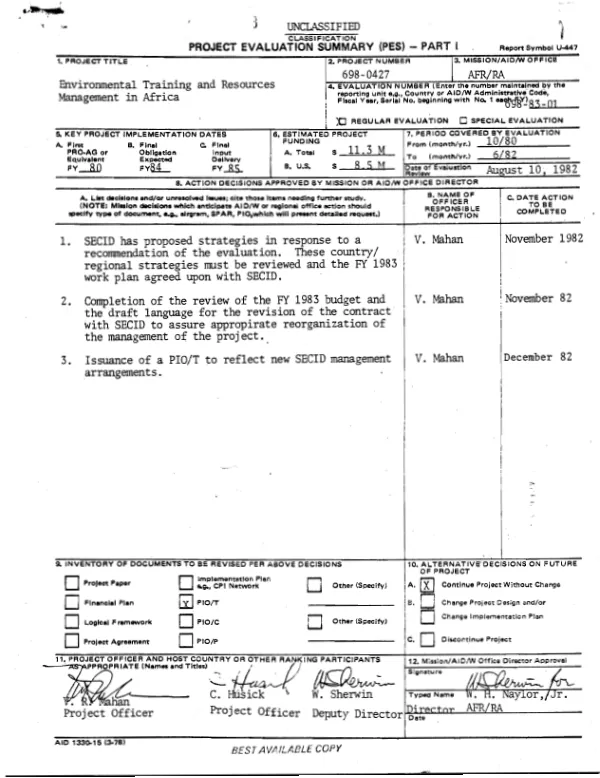
Evaluation of environmental training and management in Africa; executive summary
Evaluates project implemented by the South-East Consortium for International Development (SECID) to establish environmental training and institution building resource management programs in Africa.
1982
Sign in to readA free account is required to download.
Abstract
Special evaluation covers the period 10/80-6/82 and is based on site visits, document review, and interviews with project personnel. Implementation has been inadequate due to the narrative (as opposed to analytical) nature of the Memoranda of Understanding and Working Agreements, unstructured management by SECID, and ineffective management by A.I.D. The environmental training component has been marked by a slow start, which resulted in a slippage in planned training activities and cost overruns of 44%, and by two structural changes - a major reduction in the number of short seminars for LDC policymakers (only two of the 17 planned through 1982 have been held) and a reduction in the duration of the medium-term courses from 4-6 to 2-3 weeks. Nonetheless, short-term courses, which have so far been attended by some 120 students, are considered potentially beneficial, while the five medium-term courses held to date (attended by 161 students) have had notable input from Africans. Long-term training activities are lagging and targets are not likely to be met. Despite adequate inputs, the resource management component has fallen short of targets, although this is an inherent risk in institution building activities and progress is being made toward long-term goals. The district environmental profiles for Kenya are nearly complete and represent the most productive activity to date. Work with Sudan's Institute for Environmental Studies also seems productive, and efforts to develop a village environmental health monitoring model in Tanzania should be continued despite their limited value to date. Drought has caused work in Botswana to be postponed. On the negative side, too much resource management work has been conducted in the United States and the work appears overly academic and detached from reality. Despite the above criticisms, the evaluators deem the project worthy of continuance provided the implementation process is restructured; recommendations to the latter end are provided.