USAID DEC
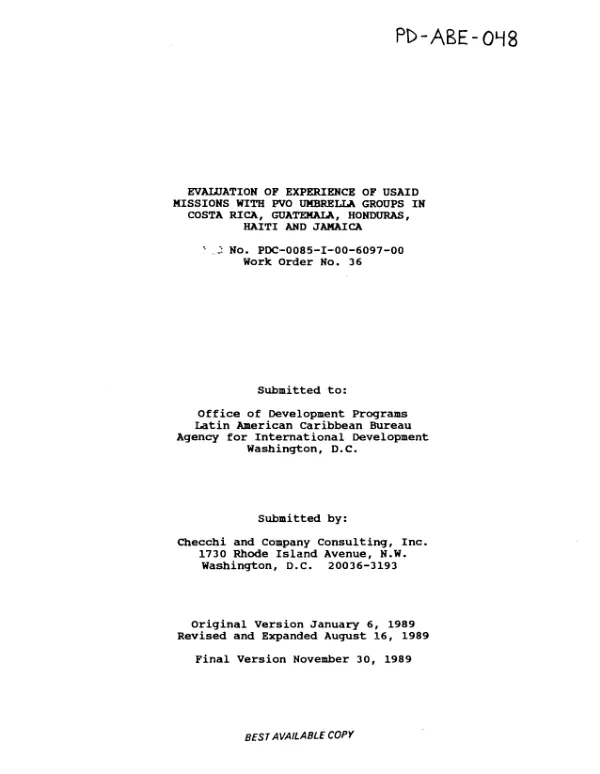
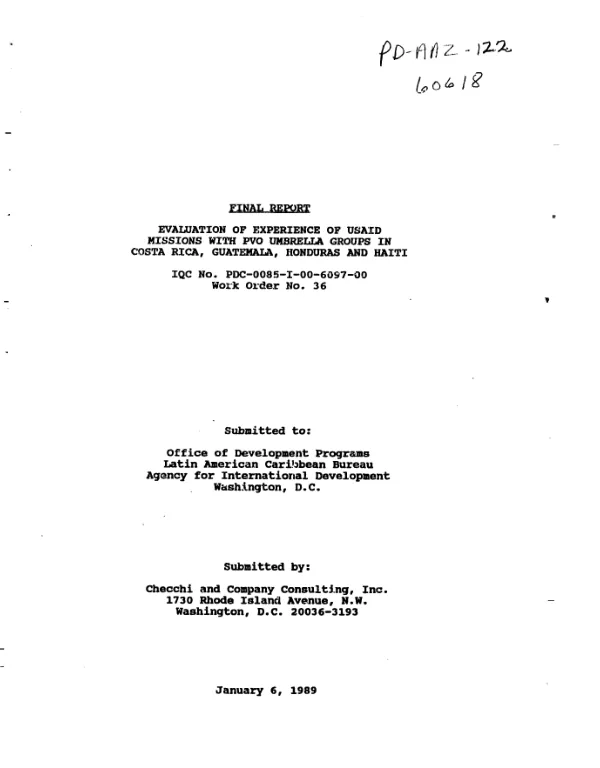
Evaluation of experience of USAID missions with PVO umbrella groups in Costa Rica, Guatemala, Honduras, Haiti and Jamaica
Sign inCHECCHI AND CO. CONSULTING, INC. (CCCI)
Evaluation of experience of USAID missions with PVO umbrella groups in Costa Rica, Guatemala, Honduras, Haiti and Jamaica
Evaluates as of 1/89 the activities of five PVO umbrella groups implementing USAID projects in Latin America and the Caribbean: the Costa Rican Association for Development Organizations (ACORDE), the Federation of Private Development Organizations of Honduras (FOPRIDEH), the Association of Non-Governmental Development and Service Entities of Guatemala (ASINDES), the Haitian Association of Voluntary Agencies (HAVA), and Jamaica's Council of Voluntary Social Services/United Way (CVSS/UW).
1989
Sign in to readA free account is required to download.
Abstract
All the organizations have demonstrated the ability to handle subproject (SP) financing as called for in the OPG's, and the available evidence, though limited, suggests that SP's are reaching their intended beneficiaries; however, systems for evaluating SP impact are not yet in place in most cases. There have been criticisms of USAID's efforts to increase the amount of assistance channeled to PVO's through umbrella organizations, especially from larger and more sophisticated PVO's who do not see the utility of such an arrangement. Training and TA programs have been less successful than SP programs. They have also, except in Haiti, received less attention, although FOPRIDEH has recently increased efforts in this area in response to member demands. Reasons for this have varied: HAVA has focused increasingly on working directly with beneficiary groups rather than PVO's; ACORDE decided to use other organizations to address training and TA objectives; and internal difficulties have undermined ASINDES' work in this area. Only FOPRIDEH and HAVA have made significant progress towards becoming representatives or coordinators of PVO's; as non-member organizations, ACORDE and CVSS/UW have not sought that responsibility, while ASINDES' membership is static, and its public role cautious. Progress has been made in institutional strengthening, especially in clarifying the purposes, basic identity, and direction of the organizations. However, more attention is needed in the areas of planning, financial management, and program evaluation. Four of the organizations have had serious staffing problems; reasons include restrictions on levels of salaries and management support, personality conflicts, and a lack of clarity concerning the roles of the Boards of Directors and the various levels of staff. Except for CVSS/UW, which has been remarkably successful in its fundraising efforts, none of organizations have much prospect of achieving financial self-sufficiency. While pursuing funding from other donors, they continue to depend heavily on U.S. resources for both operating expenses (except for ACORDE, which operates in a USAID-donated building) and program levels. Major conclusions are as follows. (1) Where USAID's principal or only purpose is to fund PVO project activities, the use of a non- membership organization is more efficient; however, if objectives include creating or strengthening an organization as a representative or coordinator for PVO activities, a membership organization is preferable. If purposes include providing TA and training as well as project funding, either type of organization can be used, depending on local circumstances and the activity involved. (2) General characteristics of effective umbrella organizations include clearly delineated internal roles and functions, established procedures and staff, and compatibility with the PVO's served. (3) The meaning of financial sustainability, and the strategies for achieving it, need greater attention. (4) While USAID's can conserve staff resources by using intermediary organizations to administer PVO project activities, it is unlikely that any one organization will be suitable for all types of USAID-supported activities, and thus that USAID's will able to avoid direct relationships with PVO's in all cases; in addition, savings in staff time will likely be realized over the long rather than the short-term, since USAID assistance will generally be necessary for the institutional development of effective organizations. (5) CVSS/UW's success in domestic fundraising is such that Missions in other countries should consider asking United Way of America and CVSS/UW for help in undertaking similar efforts.
Related documents
Documents in this collection
 1989
1989USAID DEC
Final report : evaluation of experience of USAID missions with PVO umbrella groups in Costa Rica, Guatemala, Honduras and Haiti
Open record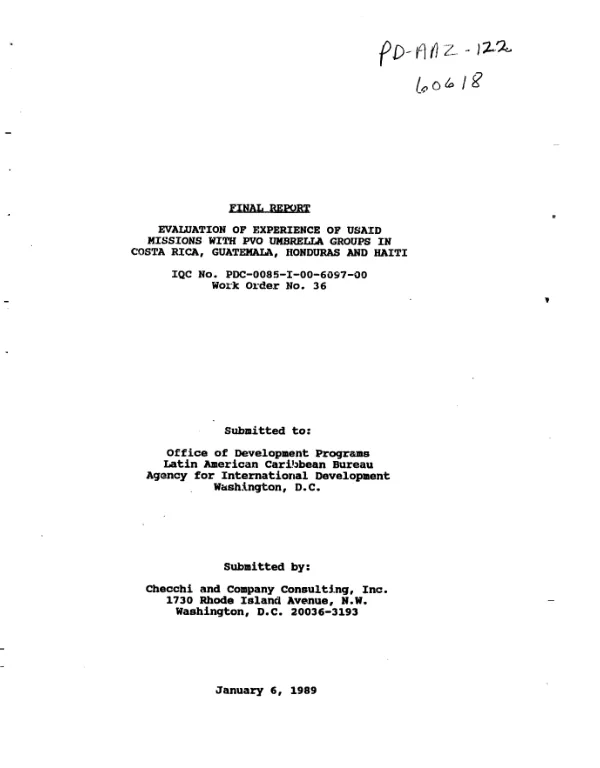 1989
1989USAID DEC