USAID DEC
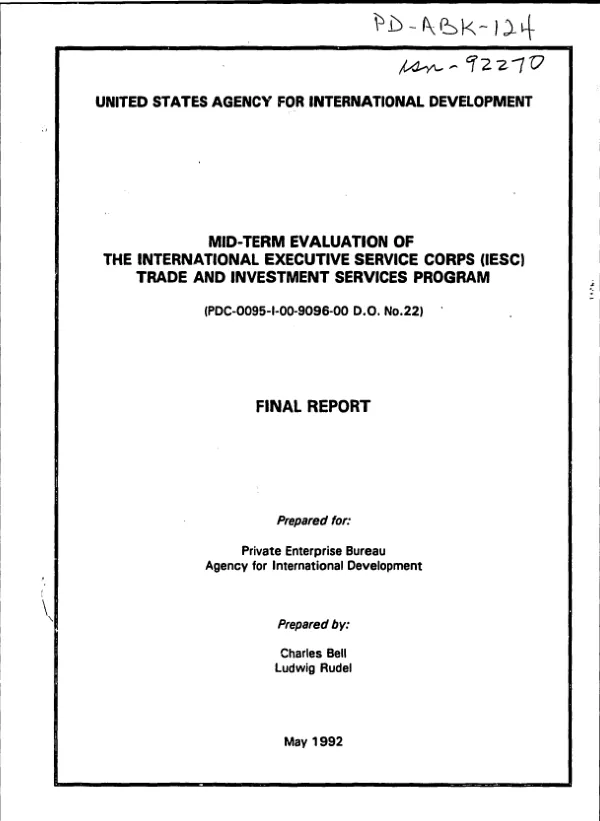
Evaluation of IESC activities funded by an AID cooperative agreement under Morocco private sector export promotion project (608-0189)
Sign inLOUIS BERGER INTERNATIONAL, INC. (LBII) DEVELOPMENT ECONOMICS GROUP
Evaluation of IESC activities funded by an AID cooperative agreement under Morocco private sector export promotion project (608-0189)
Evaluates activities conducted by the International Executive Service Corps (IESC) under USAID/M"s Private Sector Export Promotion Project.
Rudel, Ludwig; Belot, Therese · 1992
Sign in to readA free account is required to download.
Abstract
The evaluation, which is based in part on a survey of IESC clients, covers the period 7/86-9/91. Overall, one cannot draw a positive conclusion about the effectiveness of IESC"s Volunteer Executive (VE) program. One hundred American VE"s have worked with a large number of Moroccan industrial producers and exporters over the past 5 years. There are a few outstanding success stories, some with large and direct benefits to the firm, and indirect benefits to the economy, but overall impact is neither evident nor statistically verifiable. One reason for the less than optimum impact is that IESC management did not exercise adequate controls to resolve individual problems as they arose. Lack of continuity due to the turnover of six IESC country directors in the 5-year period has had negative effects. These problems have been compounded by USAID/M"s efforts to exert excessive management control, resulting in a loss of confidence by each party in the other. Lack of official organizational status for IESC has not been a major factor, but it has added to costs and caused inconvenience. More positively, the IESC Trade and Investment Service (TIS), which began operations in 1989, has been among the most effective private sector export promotion efforts on record. TIS can document 22 exporters who have been assisted in obtaining firm, valid export orders to the United States in the aggregate amount of $6,558,333. The Moroccan producers see the TIS"s most important contribution as the contacts and referrals provided to U.S. importers and brokers, and the credibility they derived from association with TIS. TIS clients do not see TIS as having played a major role in their investment decisions, but the observed reality is that TIS has indeed generated new investment by its clients, and seems to be close to achieving two joint ventures. The exports generated by TIS are also reaching backwards to positively affect other segments of the Moroccan economy. TIS is performing the services and covering costs that are characteristic of "entry costs" in penetrating new markets. Once a sufficiently large flow of product has been established, TIS assistance will no longer be needed. It is not clear that client fees would serve any useful purpose. Moreover, it could expose IESC and USAID to claims for damages from dissatisfied Moroccan clients. (Author abstract, modified)
Related documents